1. what drives the endless cycle of water on earth?\n a. energy from sunlight and gravity\n b. energy from…
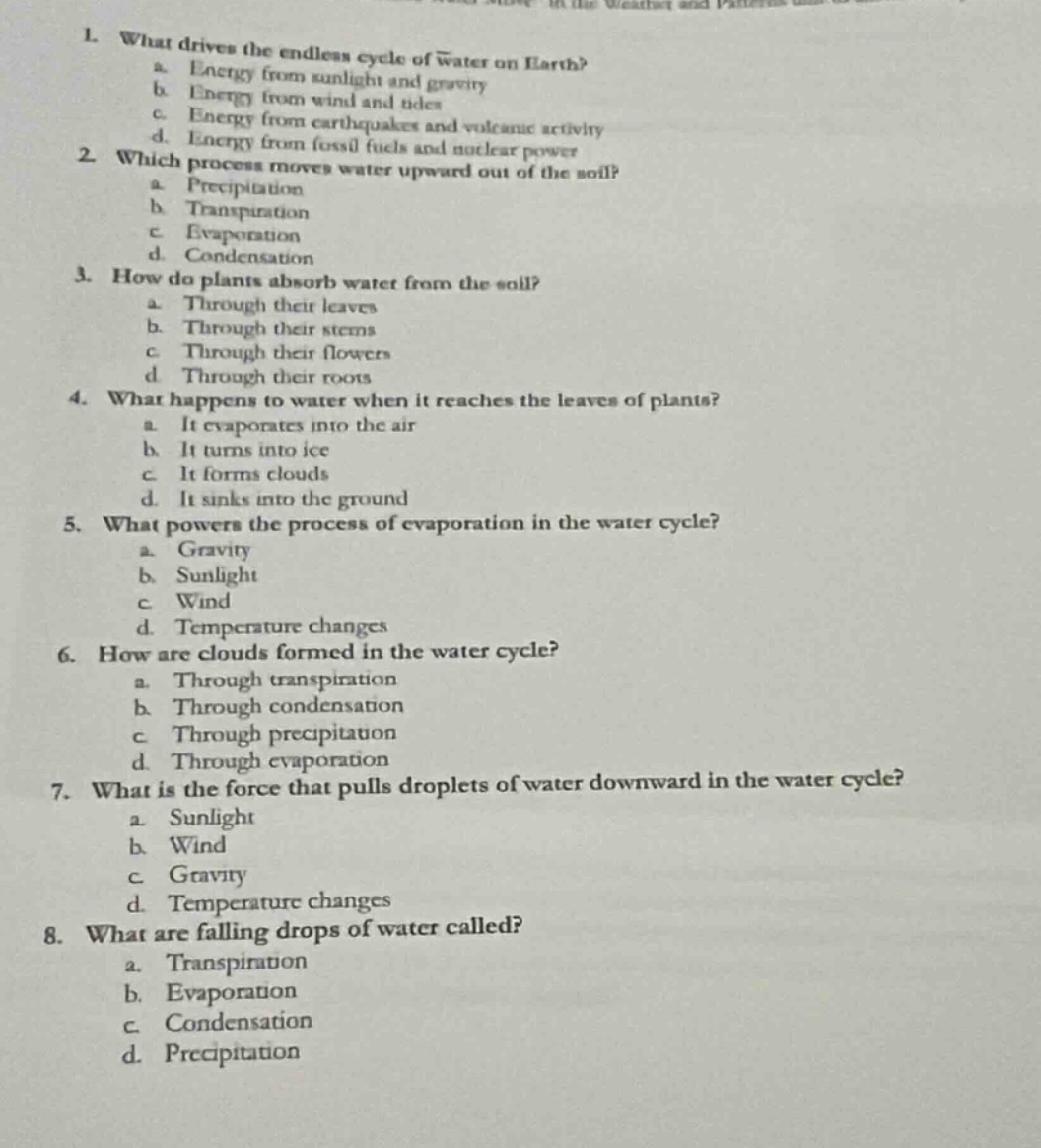
1. what drives the endless cycle of water on earth?\n a. energy from sunlight and gravity\n b. energy from wind and tides\n c. energy from earthquakes and volcanic activity\n d. energy from fossil fuels and nuclear power\n2. which process moves water upward out of the soil?\n a. precipitation\n b. transpiration\n c. evaporation\n d. condensation\n3. how do plants absorb water from the soil?\n a. through their leaves\n b. through their stems\n c. through their flowers\n d. through their roots\n4. what happens to water when it reaches the leaves of plants?\n a. it evaporates into the air\n b. it turns into ice\n c. it forms clouds\n d. it sinks into the ground\n5. what powers the process of evaporation in the water cycle?\n a. gravity\n b. sunlight\n c. wind\n d. temperature changes\n6. how are clouds formed in the water cycle?\n a. through transpiration\n b. through condensation\n c. through precipitation\n d. through evaporation\n7. what is the force that pulls droplets of water downward in the water cycle?\n a. sunlight\n b. wind\n c. gravity\n d. temperature changes\n8. what are falling drops of water called?\n a. transpiration\n b. evaporation\n c. condensation\n d. precipitation
Answer
Brief Explanations:
- The water - cycle on Earth is driven by energy from sunlight (for evaporation) and gravity (for precipitation and runoff), so the answer is b.
- Transpiration is the process by which plants move water upward out of the soil, so the answer is b.
- Plants absorb water from the soil through their roots, so the answer is d.
- When water reaches the leaves of plants, it evaporates into the air, so the answer is a.
- Sunlight powers the process of evaporation in the water - cycle by providing the energy needed to change water from a liquid to a gas, so the answer is b.
- Clouds are formed through condensation, when water vapor in the air cools and changes back to liquid droplets, so the answer is b.
- Gravity is the force that pulls droplets of water downward in the water - cycle, so the answer is c.
- Falling drops of water are called precipitation, so the answer is d.
Answer:
- b. Energy from sunlight and gravity
- b. Transpiration
- d. Through their roots
- a. It evaporates into the air
- b. Sunlight
- b. Through condensation
- c. Gravity
- d. Precipitation