ed records the temperature of two pots of water. the pots are the same size and material. pot x has a…
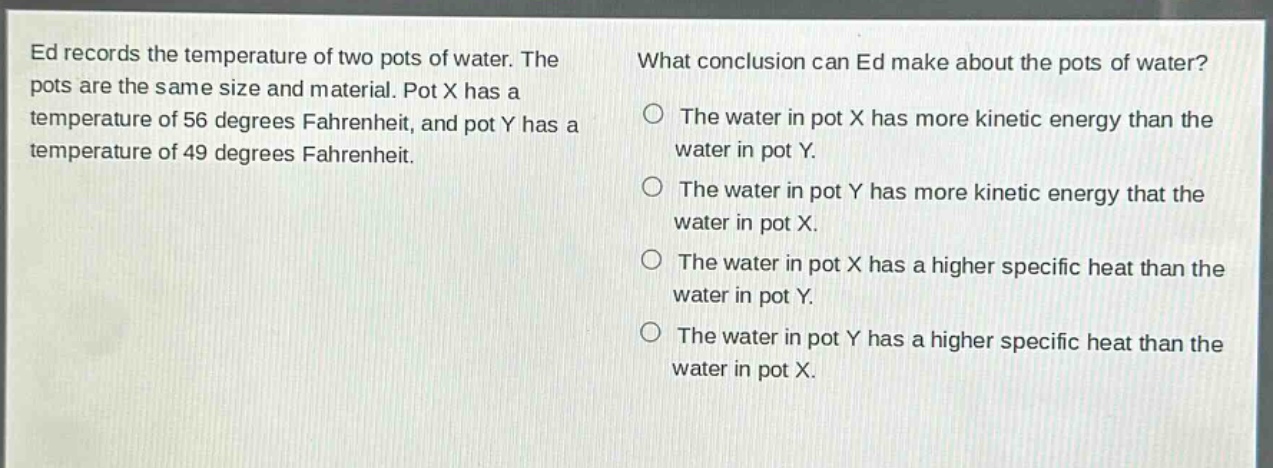
ed records the temperature of two pots of water. the pots are the same size and material. pot x has a temperature of 56 degrees fahrenheit, and pot y has a temperature of 49 degrees fahrenheit. what conclusion can ed make about the pots of water? the water in pot x has more kinetic energy than the water in pot y. the water in pot y has more kinetic energy that the water in pot x. the water in pot x has a higher specific heat than the water in pot y. the water in pot y has a higher specific heat than the water in pot x.
Answer
Explanation:
Step1: Recall kinetic - energy and temperature relation
The average kinetic energy of particles in a substance is directly proportional to its temperature.
Step2: Compare temperatures
Pot X has a temperature of 56°F and pot Y has a temperature of 49°F. Since 56°F > 49°F.
Step3: Determine kinetic - energy conclusion
The water in the pot with the higher temperature (pot X) has more kinetic energy. Specific heat is a property of the substance (water in this case) and does not depend on the temperature of the sample, so the specific - heat statements are incorrect.
Answer:
The water in pot X has more kinetic energy than the water in pot Y.