an electron in a hydrogen atom moves from level 3 to level 1. in a second hydrogen atom, an electron drops…
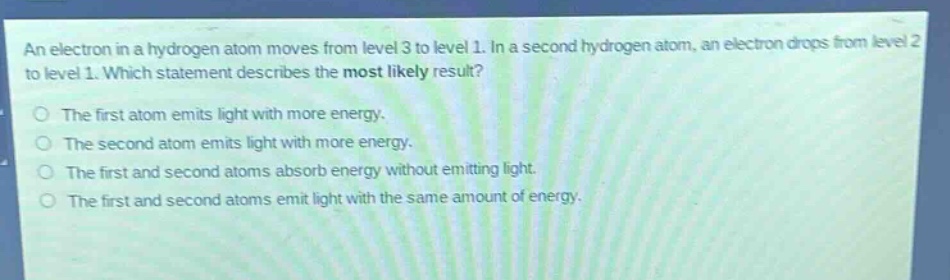
an electron in a hydrogen atom moves from level 3 to level 1. in a second hydrogen atom, an electron drops from level 2 to level 1. which statement describes the most likely result? the first atom emits light with more energy. the second atom emits light with more energy. the first and second atoms absorb energy without emitting light. the first and second atoms emit light with the same amount of energy.
Answer
Explanation:
Step1: Recall energy - level formula
The energy of an electron transition in a hydrogen - atom is given by $\Delta E = E_f - E_i$, where $E_n=-\frac{13.6}{n^2}\text{ eV}$.
Step2: Calculate energy for first transition
For the electron moving from $n = 3$ to $n = 1$: $E_1=-\frac{13.6}{1^2}=- 13.6\text{ eV}$, $E_3=-\frac{13.6}{3^2}=-\frac{13.6}{9}\approx - 1.51\text{ eV}$ $\Delta E_1=E_1 - E_3=-13.6-(-1.51)=-13.6 + 1.51=-12.09\text{ eV}$ (magnitude is $12.09\text{ eV}$)
Step3: Calculate energy for second transition
For the electron moving from $n = 2$ to $n = 1$: $E_2=-\frac{13.6}{2^2}=-3.4\text{ eV}$ $\Delta E_2=E_1 - E_2=-13.6-(-3.4)=-13.6 + 3.4=-10.2\text{ eV}$ (magnitude is $10.2\text{ eV}$)
Step4: Compare energies
Since $12.09\text{ eV}>10.2\text{ eV}$, the first atom emits light with more energy.
Answer:
The first atom emits light with more energy.