elements * almost all rock planets contain the same elements: magnesium, iron, oxygen, carbon and silicon…
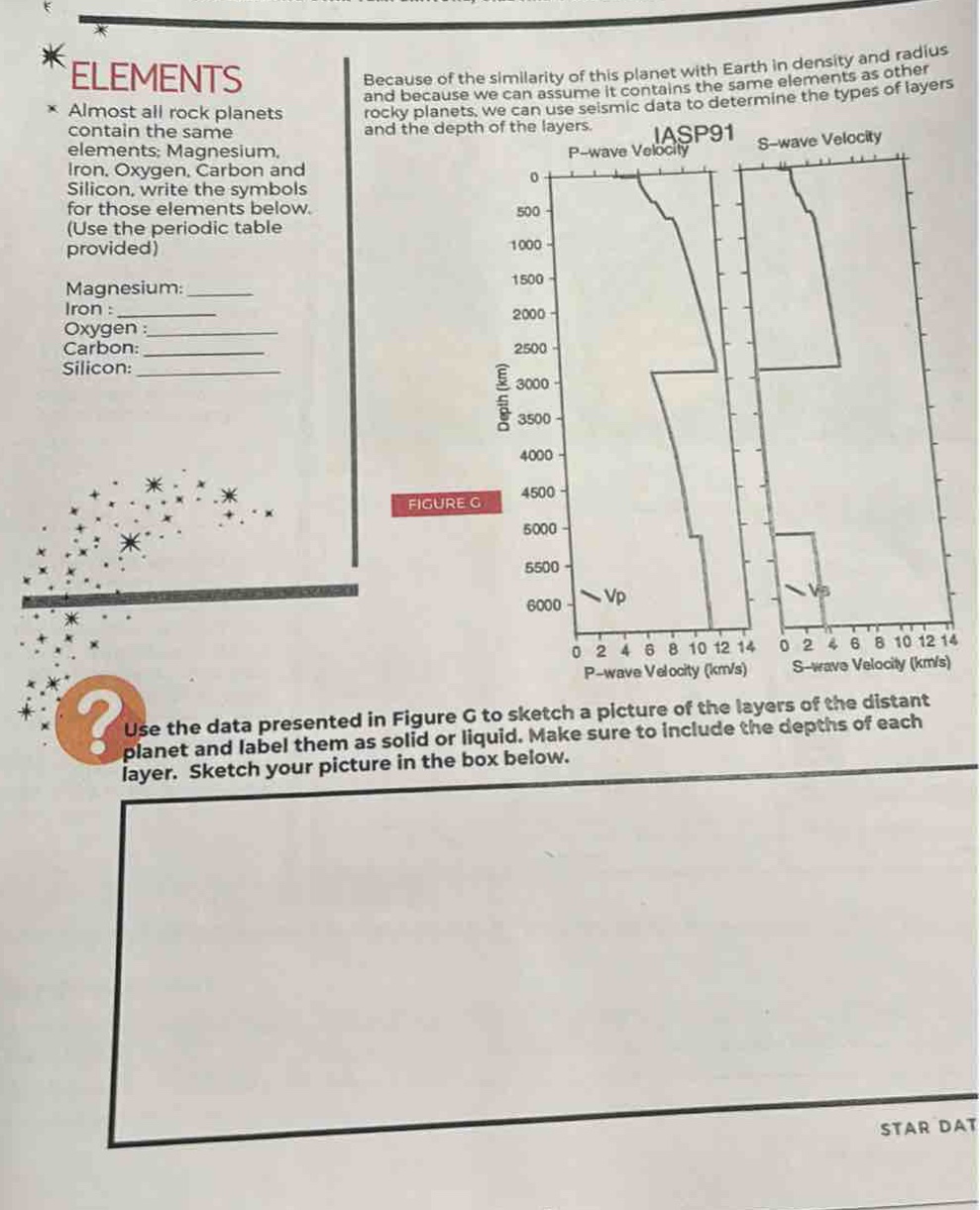
elements * almost all rock planets contain the same elements: magnesium, iron, oxygen, carbon and silicon, write the symbols for those elements below. (use the periodic table provided) magnesium: ______ iron: ______ oxygen: ______ carbon: ______ silicon: ______ because of the similarity of this planet with earth in density and radius and because we can assume it contains the same elements as other rocky planets, we can use seismic data to determine the types of layers and the depth of the layers. iasp91 p - wave velocity s - wave velocity use the data presented in figure g to sketch a picture of the layers of the distant planet and label them as solid or liquid. make sure to include the depths of each layer. sketch your picture in the box below.
Answer
Explanation:
Step1: Recall element symbols
Magnesium has symbol Mg, iron is Fe, oxygen is O, carbon is C, and silicon is Si.
Step2: Analyze seismic - wave data for layer sketch
P - waves can travel through solids and liquids, while S - waves can only travel through solids. By observing the changes in P - wave and S - wave velocities in Figure G, we can determine the boundaries of different layers and their states. However, since we can't actually draw in this text - based response, we describe the general process. Identify the depth values where there are significant changes in wave velocities. Mark these depths on the sketch. Label the regions where S - waves can travel as solid and the regions where S - waves cannot travel (but P - waves can) as liquid.
Answer:
Magnesium: Mg Iron: Fe Oxygen: O Carbon: C Silicon: Si (For the layer sketch, follow the above - described process to draw in the provided box in the original problem.)