eli moves his hand back and forth slowly, creating a longitudinal wave in the spring toy. then, he moves his…
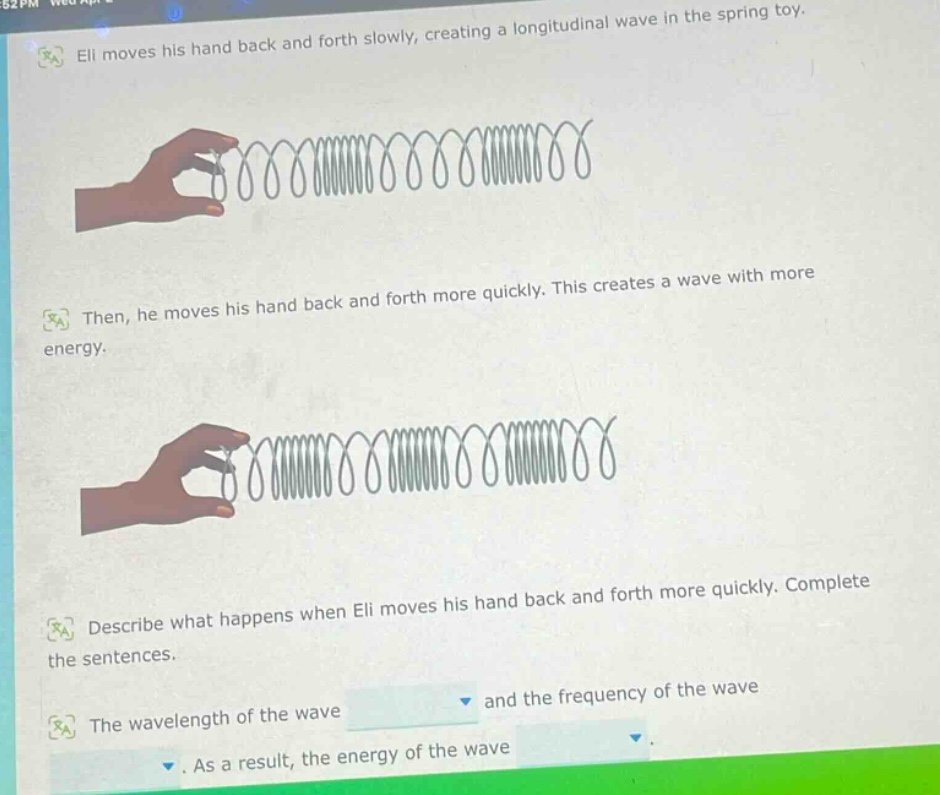
eli moves his hand back and forth slowly, creating a longitudinal wave in the spring toy. then, he moves his hand back and forth more quickly. this creates a wave with more energy. describe what happens when eli moves his hand back and forth more quickly. complete the sentences. the wavelength of the wave and the frequency of the wave. as a result, the energy of the wave
Answer
Answer:
The wavelength of the wave decreases, the frequency of the wave increases. As a result, the energy of the wave increases.
Explanation:
Step1: Recall wave - property relationships
When the source (hand movement) is faster, wave properties change.
Step2: Analyze wavelength change
Faster hand movement means more wave - cycles in the same length of the spring, so wavelength $\lambda$ decreases.
Step3: Analyze frequency change
Frequency $f$ is the number of waves per unit time. Faster hand movement leads to more waves per second, so frequency increases.
Step4: Analyze energy change
The energy $E$ of a wave is related to its frequency ($E = hf$, where $h$ is Planck's constant). Since frequency increases, energy of the wave increases.