if all else is constant, which would cause the greatest increase in kinetic energy of a moving object?\nmass…
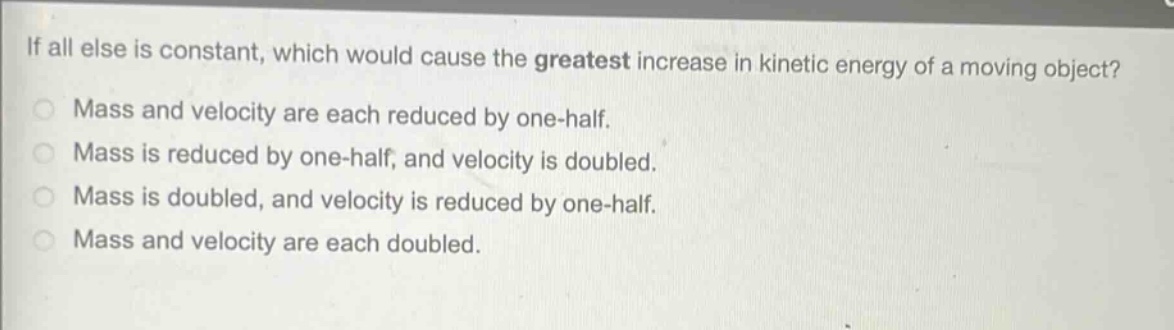
if all else is constant, which would cause the greatest increase in kinetic energy of a moving object?\nmass and velocity are each reduced by one - half.\nmass is reduced by one - half, and velocity is doubled.\nmass is doubled, and velocity is reduced by one - half.\nmass and velocity are each doubled.
Answer
Explanation:
Step1: Recall kinetic - energy formula
The formula for kinetic energy is $K = \frac{1}{2}mv^{2}$, where $m$ is mass and $v$ is velocity.
Step2: Analyze Option 1
If $m$ becomes $\frac{m}{2}$ and $v$ becomes $\frac{v}{2}$, then the new kinetic - energy $K_1=\frac{1}{2}(\frac{m}{2})(\frac{v}{2})^{2}=\frac{1}{2}\times\frac{m}{2}\times\frac{v^{2}}{4}=\frac{1}{16}mv^{2}$, a decrease.
Step3: Analyze Option 2
If $m$ becomes $\frac{m}{2}$ and $v$ becomes $2v$, then the new kinetic - energy $K_2=\frac{1}{2}(\frac{m}{2})(2v)^{2}=\frac{1}{2}\times\frac{m}{2}\times4v^{2}=mv^{2}$.
Step4: Analyze Option 3
If $m$ becomes $2m$ and $v$ becomes $\frac{v}{2}$, then the new kinetic - energy $K_3=\frac{1}{2}(2m)(\frac{v}{2})^{2}=\frac{1}{2}\times2m\times\frac{v^{2}}{4}=\frac{1}{4}mv^{2}$.
Step5: Analyze Option 4
If $m$ becomes $2m$ and $v$ becomes $2v$, then the new kinetic - energy $K_4=\frac{1}{2}(2m)(2v)^{2}=\frac{1}{2}\times2m\times4v^{2}=4mv^{2}$.
Answer:
Mass and velocity are each doubled.