the emission spectrum of hydrogen shows discrete, bright, colored lines. which characteristic of the bohr…
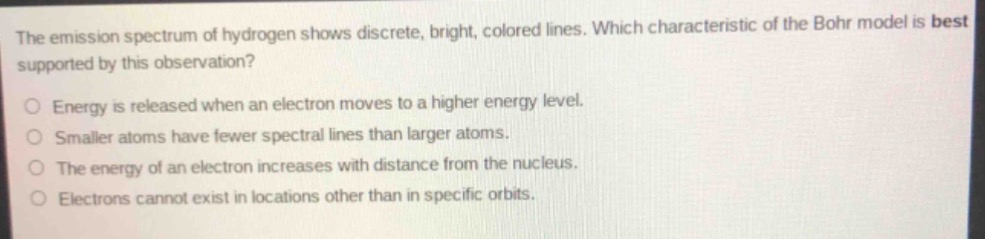
the emission spectrum of hydrogen shows discrete, bright, colored lines. which characteristic of the bohr model is best supported by this observation?\no energy is released when an electron moves to a higher energy level.\no smaller atoms have fewer spectral lines than larger atoms.\no the energy of an electron increases with distance from the nucleus.\no electrons cannot exist in locations other than in specific orbits.
Answer
Brief Explanations:
The discrete lines in the hydrogen - emission spectrum imply quantized energy levels. In the Bohr model, electrons can only occupy specific orbits with quantized energies. When an electron transitions between these orbits, it emits or absorbs a photon with a specific energy corresponding to the energy difference between the orbits, resulting in discrete spectral lines. The idea that electrons cannot exist in locations other than in specific orbits supports the observation of discrete spectral lines. Energy is absorbed when an electron moves to a higher energy level, not released. The relationship between atom size and number of spectral lines is not the best explanation for discrete lines in hydrogen's spectrum. While the energy of an electron increasing with distance from the nucleus is a feature of the Bohr model, it doesn't directly explain the discrete lines as well as the specific - orbit concept.
Answer:
Electrons cannot exist in locations other than in specific orbits.