encoding digital signals\nan electromagnetic wave is modulated differently when digital information is…
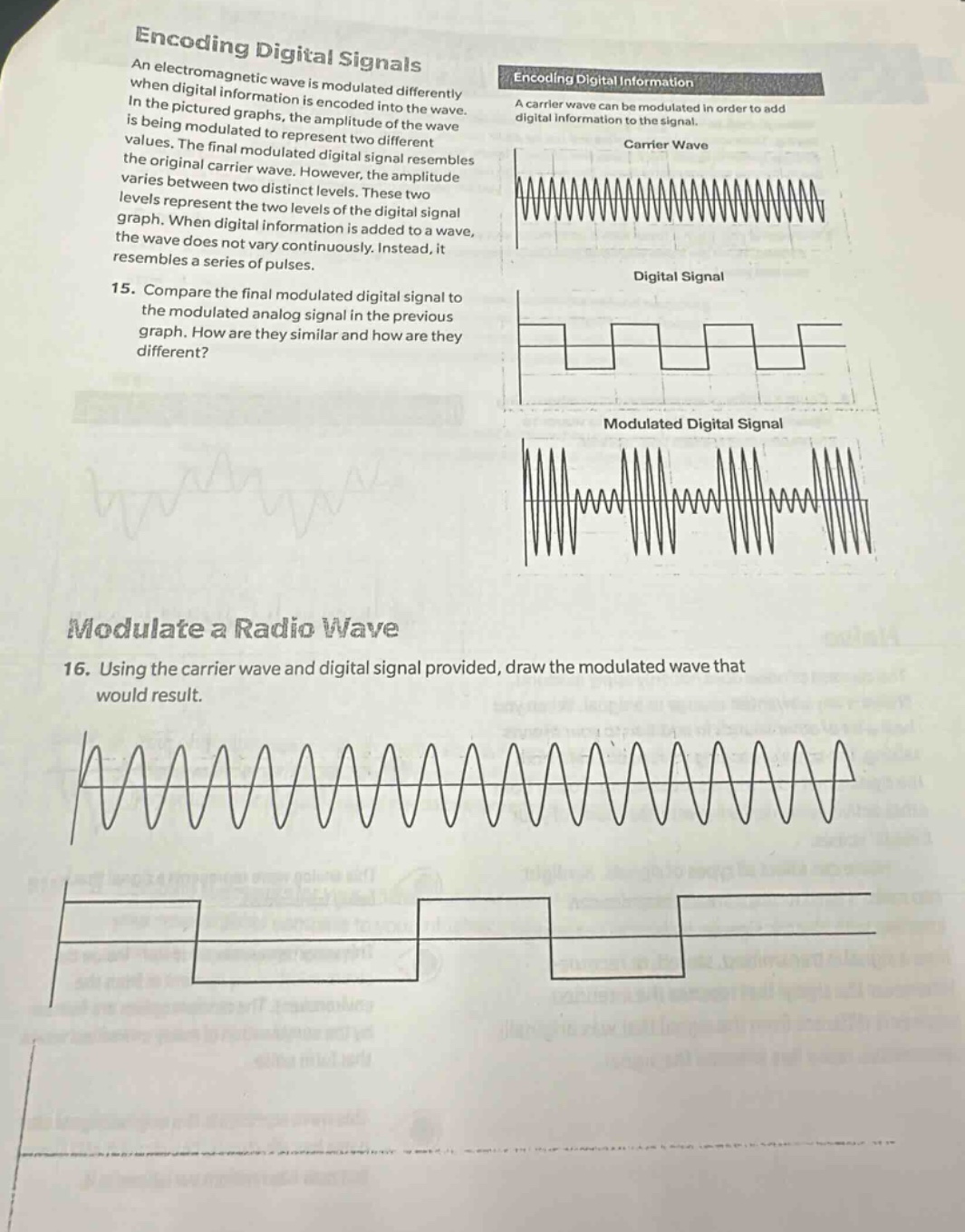
encoding digital signals\nan electromagnetic wave is modulated differently when digital information is encoded into the wave. in the pictured graphs, the amplitude of the wave is being modulated to represent two different values. the final modulated digital signal resembles the original carrier wave. however, the amplitude varies between two distinct levels. these two levels represent the two levels of the digital signal graph. when digital information is added to a wave, the wave does not vary continuously. instead, it resembles a series of pulses.\n15. compare the final modulated digital signal to the modulated analog signal in the previous graph. how are they similar and how are they different?\nmodulate a radio wave\n16. using the carrier wave and digital signal provided, draw the modulated wave that would result.
Answer
Explanation:
Step1: Analyze similarities
Both are modulated waves carrying information. The amplitude of both is modified based on the input information (digital or analog).
Step2: Analyze differences
The modulated digital signal has amplitude that varies between two distinct levels in a non - continuous, pulsed manner. The modulated analog signal has a continuously varying amplitude that can take on a range of values.
Answer:
Similarities: Both are modulated waves with amplitude modified by input information. Differences: Digital has non - continuous, pulsed amplitude between two levels; analog has continuously varying amplitude.
For question 16, this is a drawing task. The general approach would be:
Explanation:
Step1: Identify high and low levels of digital signal
Determine when the digital signal is at its high and low levels.
Step2: Modulate carrier wave
When the digital signal is at the high level, increase the amplitude of the carrier wave (or change it according to the modulation scheme rules, like amplitude modulation). When at the low level, decrease the amplitude (or make the appropriate change). Then draw the resulting wave.
Answer:
Draw a wave where the amplitude of the carrier wave is adjusted according to the high and low levels of the provided digital signal. When the digital signal is high, the carrier wave has a higher amplitude; when low, a lower amplitude.