the energy of microwaves is less than the energy of ultraviolet light. which comparison of the energies of…
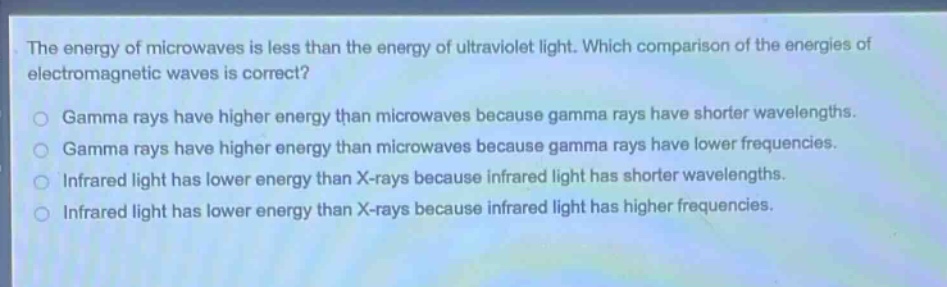
the energy of microwaves is less than the energy of ultraviolet light. which comparison of the energies of electromagnetic waves is correct?\ngamma rays have higher energy than microwaves because gamma rays have shorter wavelengths.\ngamma rays have higher energy than microwaves because gamma rays have lower frequencies.\ninfrared light has lower energy than x - rays because infrared light has shorter wavelengths.\ninfrared light has lower energy than x - rays because infrared light has higher frequencies.
Answer
Explanation:
Step1: Recall the relationship between energy, frequency and wavelength of electromagnetic waves
The energy (E) of an electromagnetic wave is given by (E = h\nu) (where (h) is Planck's constant and (\nu) is the frequency) and also (c=\lambda\nu) (where (c) is the speed of light and (\lambda) is the wavelength). So (E=\frac{hc}{\lambda}). Energy is directly proportional to frequency and inversely proportional to wavelength.
Step2: Analyze each option
- Option 1: Gamma rays have shorter wavelengths than microwaves. Using (E=\frac{hc}{\lambda}), shorter wavelength means higher energy. So gamma rays have higher energy than microwaves.
- Option 2: Since (E = h\nu), lower frequency means lower energy. Gamma rays have higher frequencies (not lower) than microwaves. So this option is wrong.
- Option 3: Infrared light has longer (not shorter) wavelengths than X - rays. Using (E=\frac{hc}{\lambda}), longer wavelength means lower energy. But the reason given (shorter wavelengths) is wrong.
- Option 4: Infrared light has lower (not higher) frequencies than X - rays. Using (E = h\nu), lower frequency means lower energy. But the reason given (higher frequencies) is wrong.
Answer:
Gamma rays have higher energy than microwaves because gamma rays have shorter wavelengths.