the engineering team analyzed four potential designs, all calculated using an 18.0 v dc power source and 2.0…
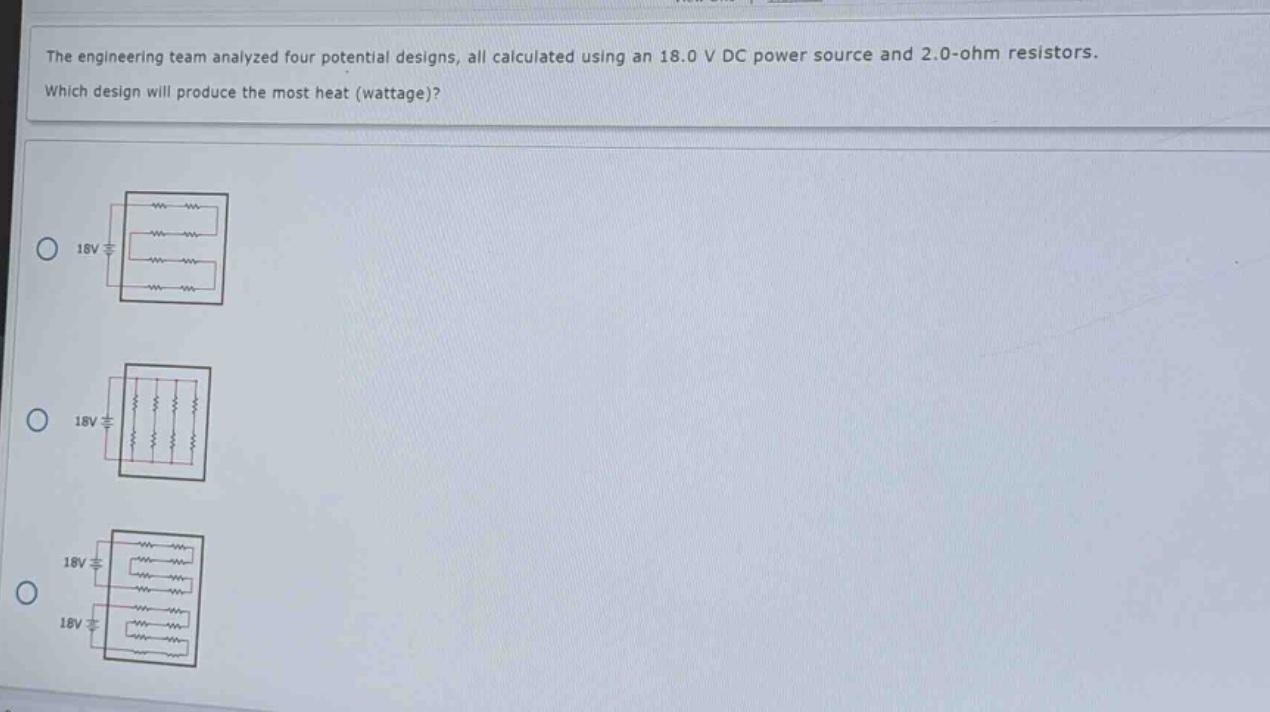
the engineering team analyzed four potential designs, all calculated using an 18.0 v dc power source and 2.0 - ohm resistors. which design will produce the most heat (wattage)?
Answer
Answer:
The design with the lowest total resistance will produce the most heat (wattage). In a parallel - circuit, the more resistors in parallel, the lower the total resistance. Assuming the second design has more resistors in parallel compared to the others (since the image shows different configurations and parallel - connected resistors reduce total resistance), the design with the most resistors in parallel will produce the most heat. Without seeing all four designs clearly, in general, for a fixed voltage source $V = 18.0$ V and resistors of $R=2.0$ - ohm each, the power formula is $P=\frac{V^{2}}{R_{total}}$. So the design with the smallest $R_{total}$ will have the highest power (wattage). If we assume the second design has the most resistors in parallel, it will have the lowest $R_{total}$ and thus produce the most heat.
Explanation:
Step1: Recall power formula
$P=\frac{V^{2}}{R_{total}}$
Step2: Analyze effect of resistance on power
For fixed $V$, lower $R_{total}$ means higher $P$.
Step3: Understand parallel - resistor effect
More resistors in parallel lower $R_{total}$.