the equation d = 13/v shows that the density of a particular substance equals a mass of 13 grams divided by…
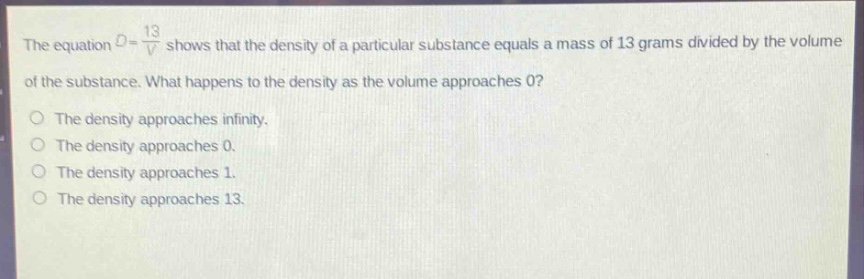
the equation d = 13/v shows that the density of a particular substance equals a mass of 13 grams divided by the volume of the substance. what happens to the density as the volume approaches 0? the density approaches infinity. the density approaches 0. the density approaches 1. the density approaches 13.
Answer
Explanation:
Step1: Analyze the density - volume relationship
The density formula is $\rho=\frac{m}{V}$, where $m = 13$ grams (constant) and $V$ is the volume. We want to find $\lim_{V\rightarrow0}\frac{13}{V}$.
Step2: Evaluate the limit
As $V$ approaches $0$ from the positive side (since volume cannot be negative in this context), the value of $\frac{13}{V}$ gets larger and larger. Mathematically, $\lim_{V\rightarrow0^{+}}\frac{13}{V}=\infty$.
Answer:
The density approaches infinity.