which equation agrees with the ideal gas law?\no $\frac{v_1}{t_1}=\frac{v_2}{t_2}$\no $v_1n_1 = v_2n_2$\no…
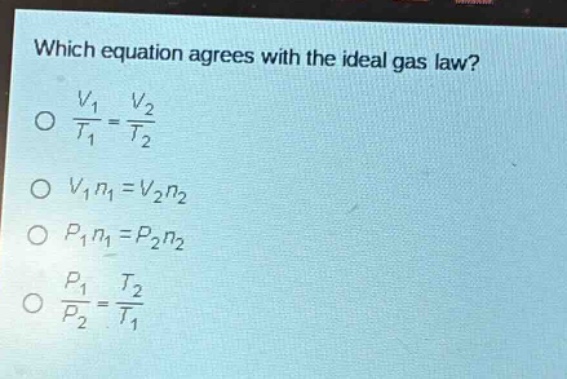
which equation agrees with the ideal gas law?\no $\frac{v_1}{t_1}=\frac{v_2}{t_2}$\no $v_1n_1 = v_2n_2$\no $p_1n_1 = p_2n_2$\no $\frac{p_1}{p_2}=\frac{t_2}{t_1}$
Answer
Explanation:
Step1: Recall ideal gas law
The ideal - gas law is given by $PV = nRT$, where $P$ is pressure, $V$ is volume, $n$ is the number of moles, $T$ is temperature, and $R$ is the ideal gas constant.
Step2: Analyze each option
- For $\frac{V_1}{T_1}=\frac{V_2}{T_2}$, this is Charles's law which is derived from the ideal - gas law when $P$ and $n$ are constant. Starting from $PV = nRT$, when $P$ and $n$ are fixed, $V=\frac{nR}{P}T$. Let $\frac{nR}{P}=k$ (a constant), then $V = kT$, and $\frac{V_1}{T_1}=\frac{V_2}{T_2}$.
- For $V_1n_1 = V_2n_2$, from $PV=nRT$, we can't directly get this relationship under any common conditions of constant variables.
- For $P_1n_1 = P_2n_2$, from $PV=nRT$, we can't directly get this relationship under any common conditions of constant variables.
- For $\frac{P_1}{P_2}=\frac{T_2}{T_1}$, from $PV = nRT$, when $V$ and $n$ are constant, $P=\frac{nR}{V}T$, so $\frac{P_1}{P_2}=\frac{T_1}{T_2}$, not $\frac{P_1}{P_2}=\frac{T_2}{T_1}$.
Answer:
$\frac{V_1}{T_1}=\frac{V_2}{T_2}$