the equation $k = \\frac{1}{2}mv^{2}$ represents the energy an object has based on its motion. the kinetic…
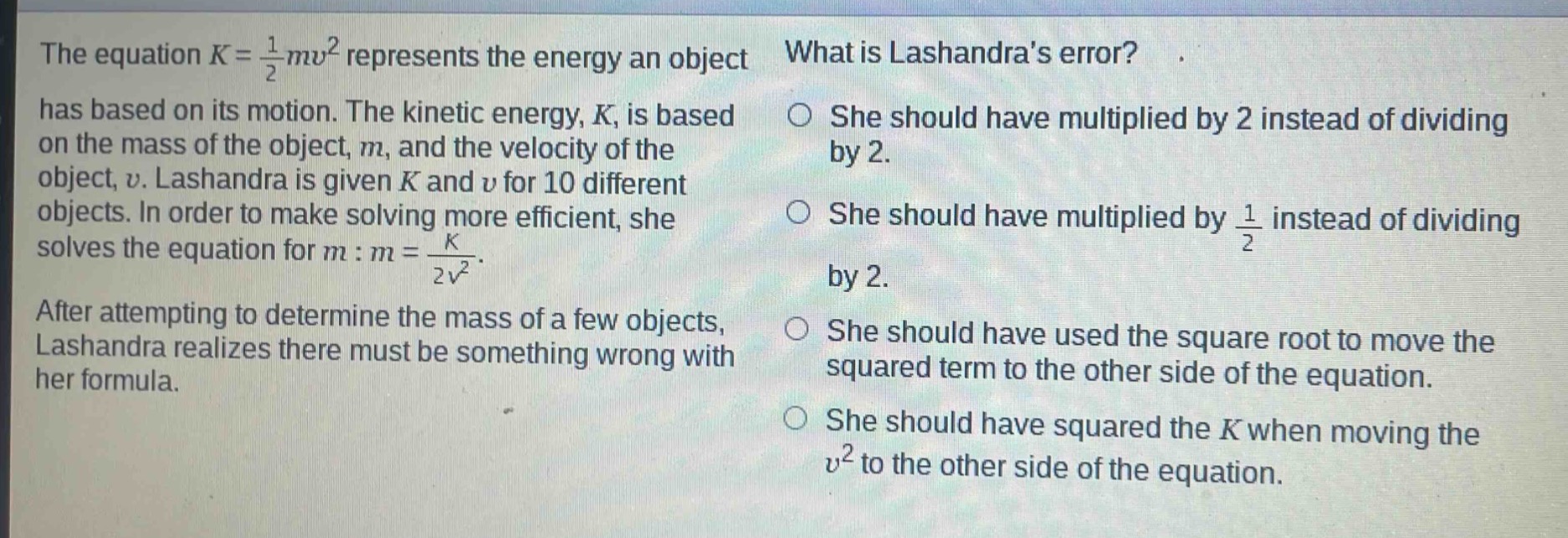
the equation $k = \\frac{1}{2}mv^{2}$ represents the energy an object has based on its motion. the kinetic energy, $k$, is based on the mass of the object, $m$, and the velocity of the object, $v$. lashandra is given $k$ and $v$ for 10 different objects. in order to make solving more efficient, she solves the equation for $m: m = \\frac{k}{2v^{2}}$. after attempting to determine the mass of a few objects, lashandra realizes there must be something wrong with her formula. what is lashandras error? she should have multiplied by 2 instead of dividing by 2. she should have multiplied by $\\frac{1}{2}$ instead of dividing by 2. she should have used the square root to move the squared term to the other side of the equation. she should have squared the $k$ when moving the $v^{2}$ to the other side of the equation.
Answer
Answer:
She should have multiplied by 2 instead of dividing by 2.
Explanation:
Step1: Start with kinetic - energy formula
$K=\frac{1}{2}mv^{2}$
Step2: Isolate $m$
Multiply both sides by 2 to get $2K = mv^{2}$. Then divide both sides by $v^{2}$: $m=\frac{2K}{v^{2}}$. Lashandra only multiplied $K$ by 1 when moving $\frac{1}{2}$ to the other side instead of multiplying by 2. So she should have multiplied by 2 instead of dividing by 2.