which equation represents the combined gas law?\n$p_1v_1 = p_2v_2$\n$\frac{v_1}{t_1}=\frac{v_2}{t_2}$\n$\frac…
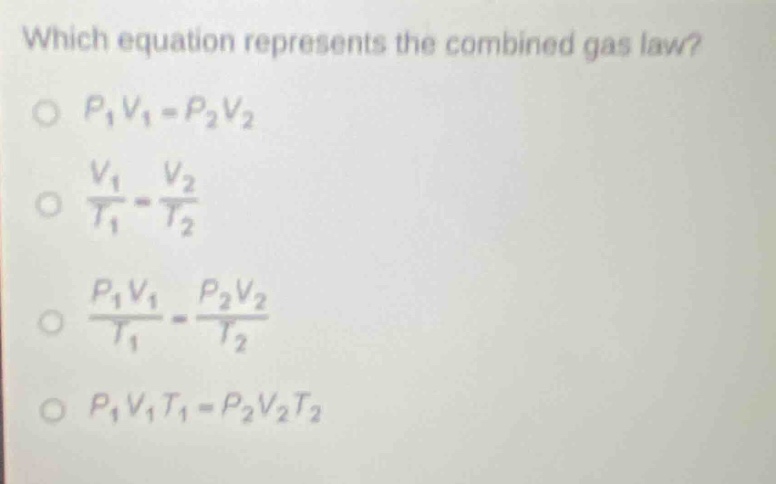
which equation represents the combined gas law?\n$p_1v_1 = p_2v_2$\n$\frac{v_1}{t_1}=\frac{v_2}{t_2}$\n$\frac{p_1v_1}{t_1}=\frac{p_2v_2}{t_2}$\n$p_1v_1t_1 = p_2v_2t_2$
Answer
Answer:
C. $\frac{P_1V_1}{T_1}=\frac{P_2V_2}{T_2}$
Explanation:
Step1: Recall gas - law concepts
The combined gas law combines Boyle's law ($P_1V_1 = P_2V_2$), Charles's law ($\frac{V_1}{T_1}=\frac{V_2}{T_2}$), and Gay - Lussac's law.
Step2: Identify the combined gas law
The combined gas law is $\frac{P_1V_1}{T_1}=\frac{P_2V_2}{T_2}$, where $P$ is pressure, $V$ is volume, and $T$ is temperature (in Kelvin) for two different states of a gas.