the equation (f = v+at) represents the final velocity of an object, (f), with an initial velocity, (v), and…
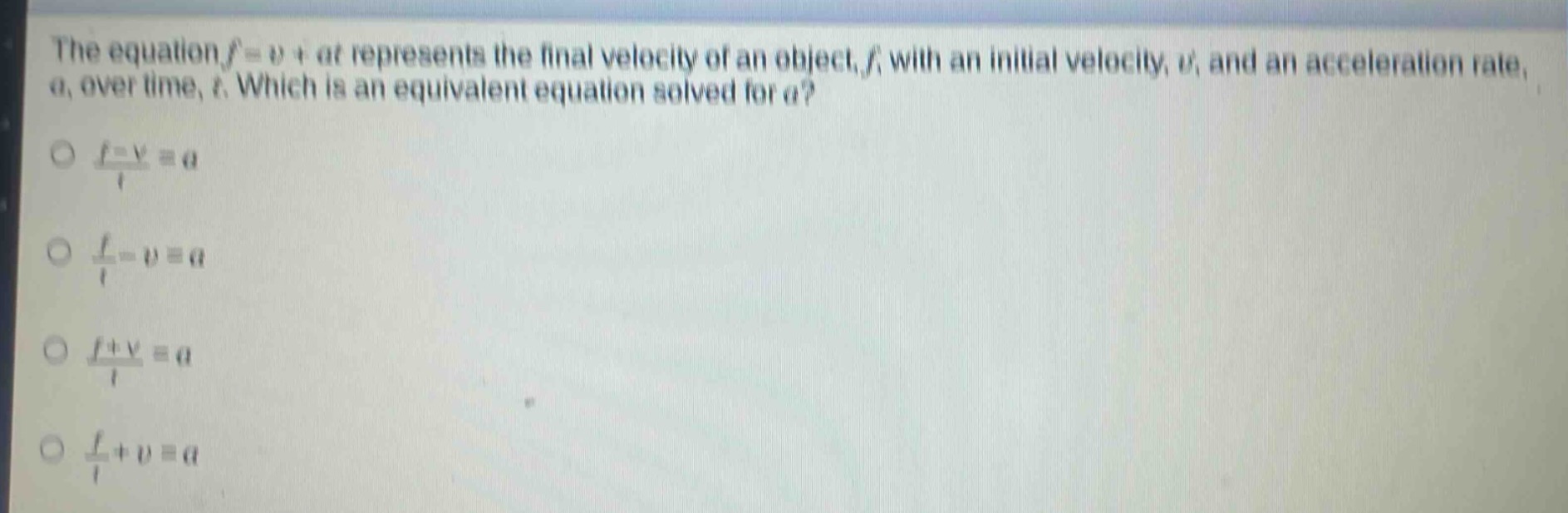
the equation (f = v+at) represents the final velocity of an object, (f), with an initial velocity, (v), and an acceleration rate, (a), over time, (t). which is an equivalent equation solved for (a)?\n(\frac{f - v}{t}=a)\n(\frac{f}{t}-v = a)\n(\frac{f + v}{t}=a)\n(\frac{f}{t}+v = a)
Answer
Answer:
$\frac{f - v}{t}=a$
Explanation:
Step1: Isolate the term with $a$
$f=v + at$ Subtract $v$ from both sides: $f - v=at$
Step2: Solve for $a$
Divide both sides by $t$: $\frac{f - v}{t}=a$