the equation (t^{2}=a^{3}) shows the relationship between a planets orbital period, (t), and the planets…
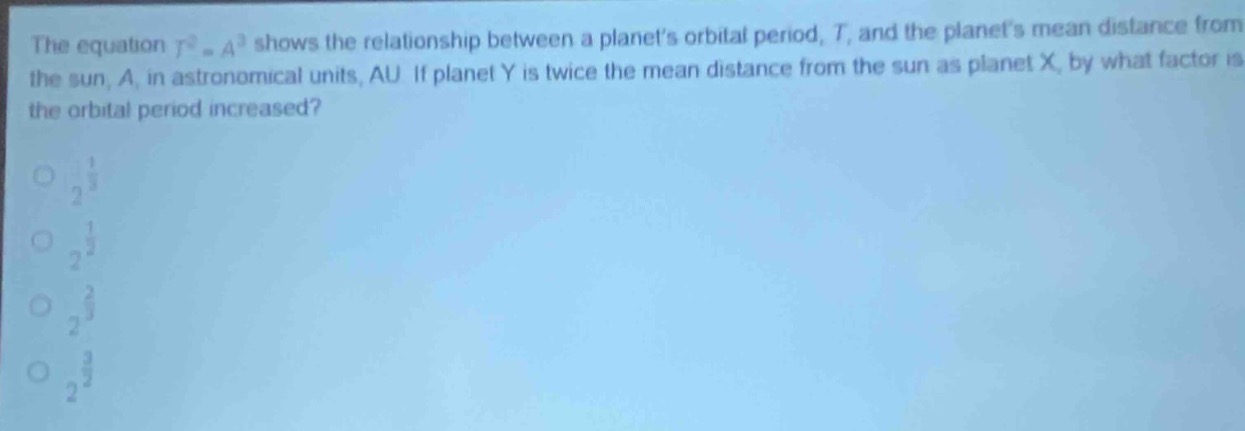
the equation (t^{2}=a^{3}) shows the relationship between a planets orbital period, (t), and the planets mean distance from the sun, (a), in astronomical units, au. if planet y is twice the mean distance from the sun as planet x, by what factor is the orbital period increased?\n\n(2^{\frac{1}{3}})\n(2^{\frac{1}{2}})\n(2^{\frac{2}{3}})\n(2^{\frac{3}{2}})
Answer
Answer:
$2^{\frac{3}{2}}$
Explanation:
Step1: Define variables for planets
Let $A_X$ be the mean - distance of planet $X$ from the sun and $T_X$ be its orbital period. So $T_X^{2}=A_X^{3}$. Let $A_Y = 2A_X$ be the mean - distance of planet $Y$ from the sun and $T_Y$ be its orbital period. So $T_Y^{2}=A_Y^{3}$.
Step2: Substitute $A_Y$ into its equation
Since $A_Y = 2A_X$, then $T_Y^{2}=(2A_X)^{3}=8A_X^{3}$.
Step3: Express $T_Y$ in terms of $T_X$
From $T_X^{2}=A_X^{3}$, we can substitute $A_X^{3}=T_X^{2}$ into the equation for $T_Y^{2}$. So $T_Y^{2}=8T_X^{2}$. Then $T_Y=\sqrt{8}T_X = 2^{\frac{3}{2}}T_X$. So the orbital period of planet $Y$ is $2^{\frac{3}{2}}$ times that of planet $X$.