example problem: an alaskan rescue plane drops a package of emergency rations to a stranded party of…
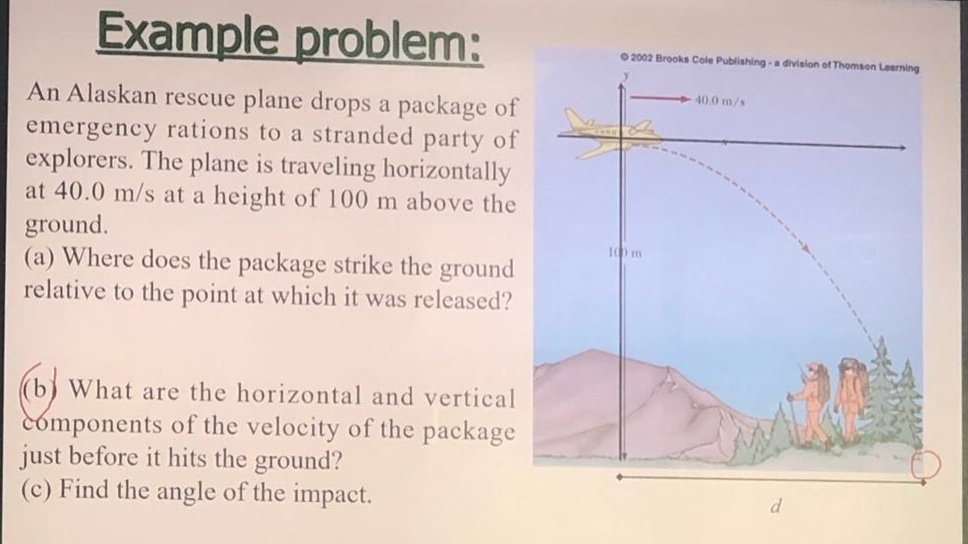
example problem: an alaskan rescue plane drops a package of emergency rations to a stranded party of explorers. the plane is traveling horizontally at 40.0 m/s at a height of 100 m above the ground. (a) where does the package strike the ground relative to the point at which it was released? (b) what are the horizontal and vertical components of the velocity of the package just before it hits the ground? (c) find the angle of the impact.
Answer
Explanation:
Step1: Calculate time of fall
The vertical - motion is a free - fall. Using the equation $y = y_0+v_{0y}t-\frac{1}{2}gt^{2}$, where $y = 0$, $y_0 = 100$ m, $v_{0y}=0$ m/s. So, $0 = 100- \frac{1}{2}(9.8)t^{2}$. Solving for $t$: $$t=\sqrt{\frac{2y_0}{g}}=\sqrt{\frac{2\times100}{9.8}}\ s\approx4.52\ s$$
Step2: Calculate horizontal distance
The horizontal motion is a uniform - motion with $v_x = 40.0$ m/s. Using the equation $x = v_x t$, substituting $v_x = 40.0$ m/s and $t = 4.52$ s, we get $x=40\times4.52 = 180.8$ m.
Step3: Find horizontal and vertical components of velocity
The horizontal component of velocity remains constant during the motion, so $v_x=40.0$ m/s. The vertical component of velocity is given by $v_y=v_{0y}-gt$. Since $v_{0y} = 0$ m/s and $t = 4.52$ s, $g = 9.8$ m/s², then $v_y=-9.8\times4.52=-44.3$ m/s.
Step4: Calculate the angle of impact
The angle of impact $\theta$ is given by $\tan\theta=\frac{v_y}{v_x}$. Substituting $v_x = 40.0$ m/s and $v_y=-44.3$ m/s, we get $\theta=\arctan\left(\frac{-44.3}{40.0}\right)\approx - 47.9^{\circ}$
Answer:
(a) $180.8$ m (b) $v_x = 40.0$ m/s, $v_y=-44.3$ m/s (c) $\theta\approx - 47.9^{\circ}$