example problem: an alaskan rescue plane drops a package of emergency rations to a stranded party of…
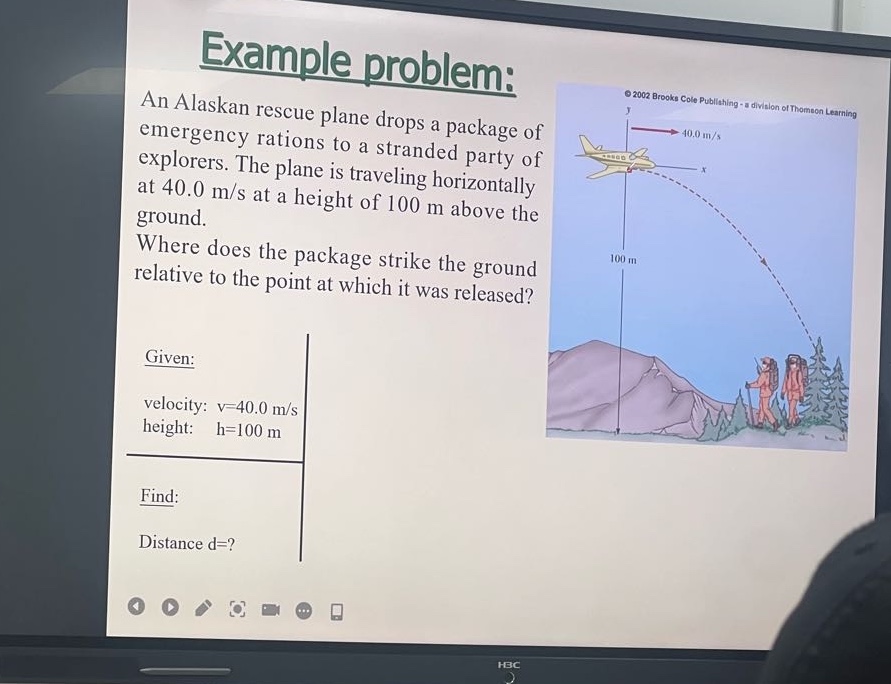
example problem: an alaskan rescue plane drops a package of emergency rations to a stranded party of explorers. the plane is traveling horizontally at 40.0 m/s at a height of 100 m above the ground. where does the package strike the ground relative to the point at which it was released? given: velocity: v = 40.0 m/s height: h = 100 m find: distance d =?
Answer
Explanation:
Step1: Analyze vertical - motion
The package is in free - fall vertically. Using the equation $h = v_{0y}t+\frac{1}{2}gt^{2}$, where $v_{0y} = 0$ (initial vertical velocity is zero as the plane is moving horizontally). So, $h=\frac{1}{2}gt^{2}$. $$100=\frac{1}{2}\times9.8t^{2}$$
Step2: Solve for time $t$
Rearranging the equation $100=\frac{1}{2}\times9.8t^{2}$ for $t$, we get $t=\sqrt{\frac{2\times100}{9.8}}\approx4.52\ s$.
Step3: Analyze horizontal - motion
Horizontally, there is no acceleration ($a_x = 0$), and the horizontal velocity $v_x$ is constant. Using the equation $d = v_x t$, with $v_x=40.0\ m/s$ and $t = 4.52\ s$. $$d=40\times4.52 = 180.8\ m$$
Answer:
$180.8\ m$