example1: level curves\nconsider a car driving at 20 m/s (~45 mph) on a level circular turn of radius 40.0…
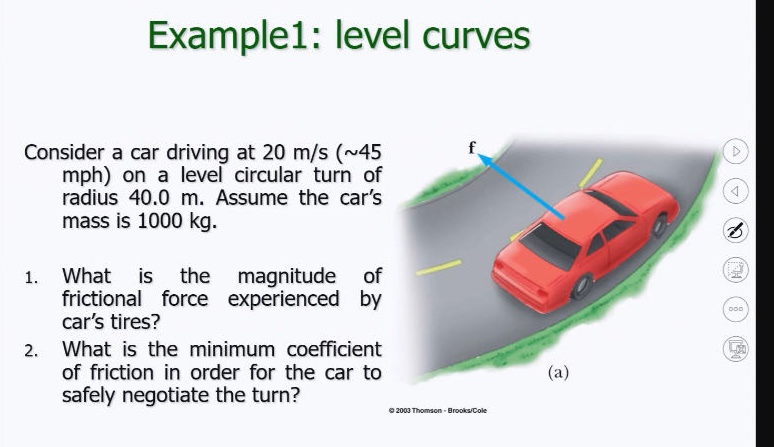
example1: level curves\nconsider a car driving at 20 m/s (~45 mph) on a level circular turn of radius 40.0 m. assume the cars mass is 1000 kg.\n1. what is the magnitude of frictional force experienced by cars tires?\n2. what is the minimum coefficient of friction in order for the car to safely negotiate the turn?
Answer
Explanation:
Step1: Identify centripetal - force formula
The centripetal force $F_c$ acting on the car is provided by the frictional force $F_f$. The centripetal - force formula is $F_c=\frac{mv^{2}}{r}$, where $m$ is the mass of the car, $v$ is the speed of the car, and $r$ is the radius of the circular path.
Step2: Calculate the frictional force
Given $m = 1000\ kg$, $v=20\ m/s$, and $r = 40.0\ m$. Substitute these values into the centripetal - force formula: $F_f=F_c=\frac{mv^{2}}{r}=\frac{1000\times20^{2}}{40}=10000\ N$.
Step3: Relate frictional force to coefficient of friction
The frictional force is given by $F_f=\mu N$, where $N$ is the normal force. On a level road, $N = mg$ (where $g = 9.8\ m/s^{2}$). We know $F_f=\mu mg$, and we want to find $\mu$. Rearranging for $\mu$ gives $\mu=\frac{F_f}{mg}$.
Step4: Calculate the coefficient of friction
Substitute $F_f = 10000\ N$, $m = 1000\ kg$, and $g=9.8\ m/s^{2}$ into the formula for $\mu$: $\mu=\frac{10000}{1000\times9.8}\approx1.02$.
Answer:
- The magnitude of the frictional force is $10000\ N$.
- The minimum coefficient of friction is approximately $1.02$.