an exoplanet is defined as a planet that orbits a star outside of our solar system. over 400 exoplanets have…
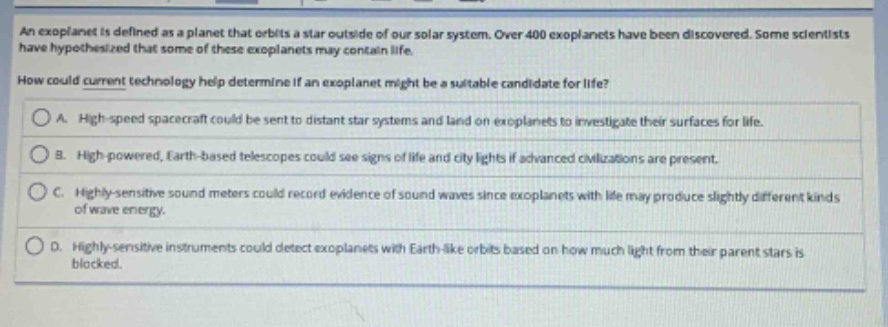
an exoplanet is defined as a planet that orbits a star outside of our solar system. over 400 exoplanets have been discovered. some scientists have hypothesized that some of these exoplanets may contain life. how could current technology help determine if an exoplanet might be a suitable candidate for life? a. high - speed spacecraft could be sent to distant star systems and land on exoplanets to investigate their surfaces for life. b. high - powered, earth - based telescopes could see signs of life and city lights if advanced civilizations are present. c. highly - sensitive sound meters could record evidence of sound waves since exoplanets with life may produce slightly different kinds of wave energy. d. highly - sensitive instruments could detect exoplanets with earth - like orbits based on how much light from their parent stars is blocked.
Answer
Brief Explanations:
- Option A is not feasible currently as high - speed spacecraft for such long - distance travel and landing on exoplanets are beyond current technology.
- Option B: Earth - based telescopes do not have the resolution to see city lights or signs of life on exoplanets at such vast distances.
- Option C: Sound cannot travel through the vacuum of space, so sound meters are useless for detecting life on exoplanets.
- Option D: Transit photometry is a well - established method. Highly - sensitive instruments can detect exoplanets by measuring the dip in a star's brightness as the exoplanet passes in front of it. This can also give information about the planet's orbit, and if it has an Earth - like orbit, it could be a candidate for life.
Answer:
D. Highly - sensitive instruments could detect exoplanets with Earth - like orbits based on how much light from their parent stars is blocked.