explain how the human eye sees objects and colors in terms of wavelengths.\nexplain why a sheet of white…
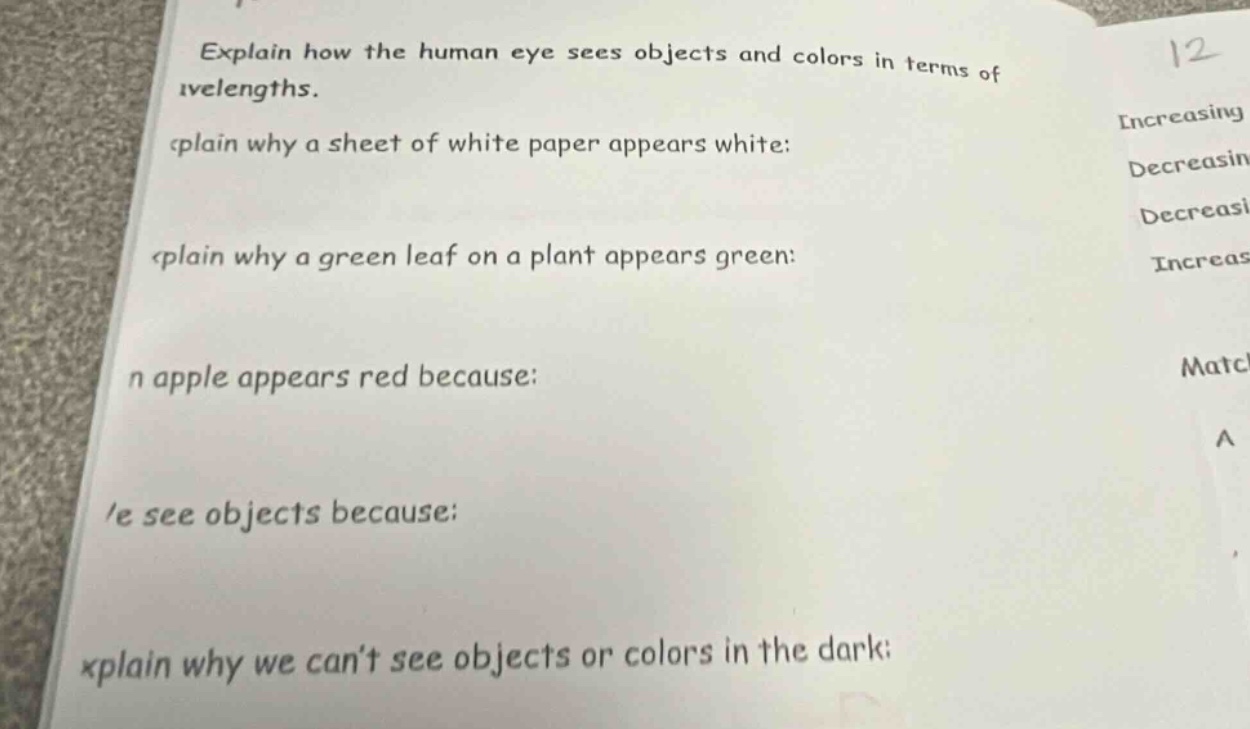
explain how the human eye sees objects and colors in terms of wavelengths.\nexplain why a sheet of white paper appears white:\nexplain why a green leaf on a plant appears green:\nan apple appears red because:\nwe see objects because:\nexplain why we cant see objects or colors in the dark:
Answer
Brief Explanations:
- The human eye sees objects and colors through light. Light is made up of different wavelengths. The eye has photoreceptor cells (rods and cones). Cones are responsible for color - vision and work best in bright light. Different cones are sensitive to different wavelengths of light corresponding to different colors.
- A sheet of white paper appears white because it reflects all wavelengths of visible light. When all visible - light wavelengths enter the eye, we perceive the color white.
- A green leaf appears green because it absorbs most wavelengths of light except those in the green range. It reflects green - wavelength light which enters the eye, making us perceive it as green.
- An apple appears red because it reflects light in the red - wavelength range and absorbs other wavelengths. The red - wavelength light enters the eye, and we see the apple as red.
- We see objects because light from the objects (either emitted or reflected) enters our eyes. This light stimulates the photoreceptor cells, which send signals to the brain via the optic nerve, and the brain interprets these signals as an image.
- We can't see objects or colors in the dark because there is no (or very little) light. Without light, there are no wavelengths to stimulate the photoreceptor cells in the eye, so the brain doesn't receive any visual signals.
Answer:
- The human eye has cones sensitive to different light - wavelengths for color - vision.
- White paper reflects all visible - light wavelengths.
- A green leaf reflects green - wavelength light.
- An apple reflects red - wavelength light.
- Light from objects enters the eye and stimulates photoreceptors.
- There is no light in the dark to stimulate the eye's photoreceptors.