the final velocity, v, of an object under constant acceleration can be found using the formula…
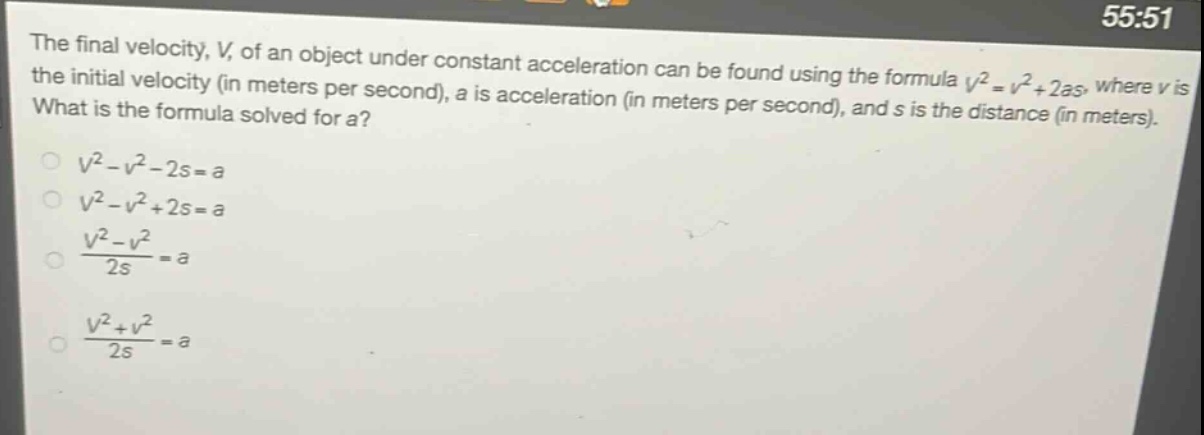
the final velocity, v, of an object under constant acceleration can be found using the formula (v^{2}=v^{2}+2as), where v is the initial velocity (in meters per second), a is acceleration (in meters per second), and s is the distance (in meters). what is the formula solved for a?\n(v^{2}-v^{2}-2s = a)\n(v^{2}-v^{2}+2s = a)\n(\frac{v^{2}-v^{2}}{2s}=a)\n(\frac{v^{2}+v^{2}}{2s}=a)
Answer
Explanation:
Step1: Isolate the term with a
Given $V^{2}=v^{2}+2as$, subtract $v^{2}$ from both sides. $V^{2}-v^{2}=2as$
Step2: Solve for a
Divide both sides by $2s$. $a = \frac{V^{2}-v^{2}}{2s}$
Answer:
C. $\frac{V^{2}-v^{2}}{2s}=a$