1. find the equivalent resistance and the voltage in the circuit below.\n2. find the equivalent resistance…
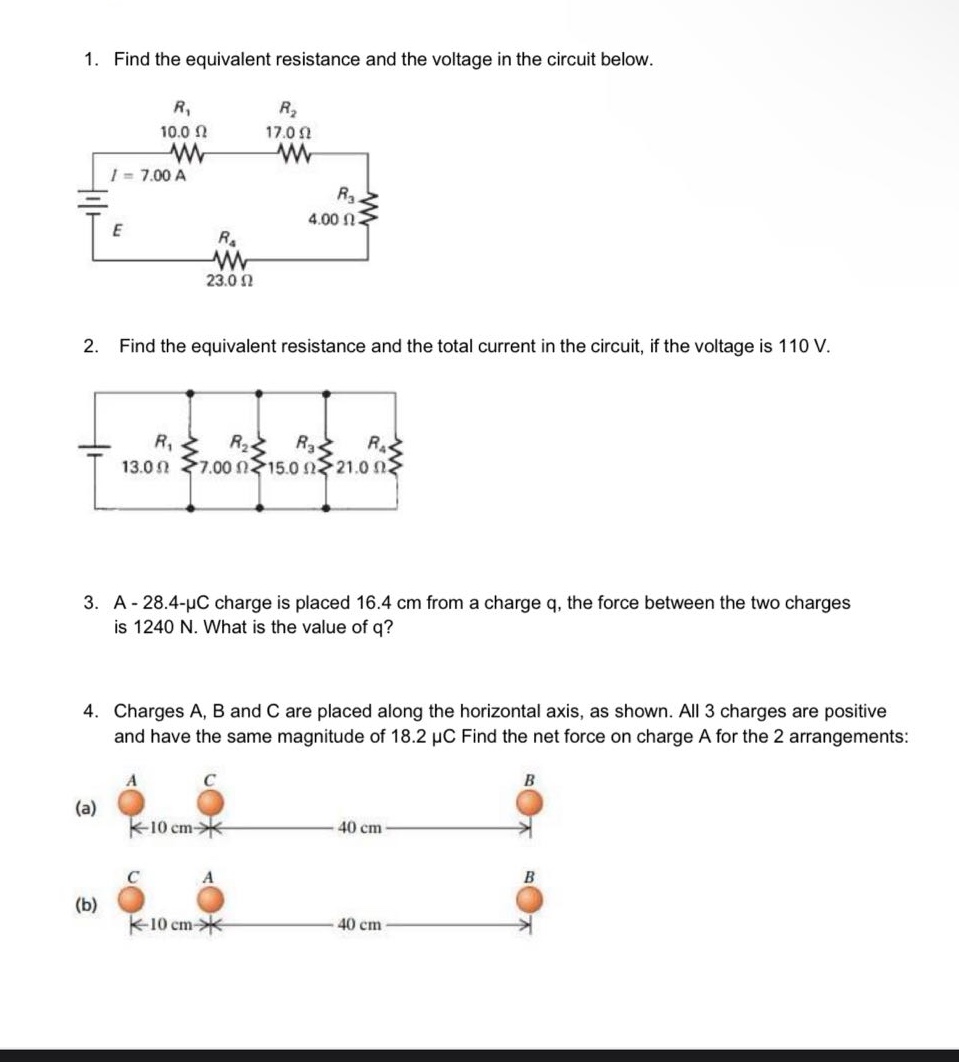
1. find the equivalent resistance and the voltage in the circuit below.\n2. find the equivalent resistance and the total current in the circuit, if the voltage is 110 v.\n3. a - 28.4 - μc charge is placed 16.4 cm from a charge q, the force between the two charges is 1240 n. what is the value of q?\n4. charges a, b and c are placed along the horizontal axis, as shown. all 3 charges are positive and have the same magnitude of 18.2 μc find the net force on charge a for the 2 arrangements:
Answer
1.
Explanation:
Step1: Calculate equivalent resistance for series - circuit
For resistors in series, the equivalent resistance $R_{eq}$ is the sum of individual resistances. Given $R_1 = 10.0\ \Omega$, $R_2=17.0\ \Omega$, $R_3 = 4.00\ \Omega$ and $R_4=23.0\ \Omega$. $R_{eq}=R_1 + R_2+R_3+R_4=10.0 + 17.0+4.00 + 23.0=54.0\ \Omega$
Step2: Calculate voltage using Ohm's law
Ohm's law is $V = IR$. Given $I = 7.00\ A$ and $R_{eq}=54.0\ \Omega$. $V=I\times R_{eq}=7.00\times54.0 = 378\ V$
Answer:
Equivalent resistance: $54.0\ \Omega$, Voltage: $378\ V$
2.
Explanation:
Step1: Calculate equivalent resistance for parallel - circuit
The formula for resistors in parallel is $\frac{1}{R_{eq}}=\frac{1}{R_1}+\frac{1}{R_2}+\frac{1}{R_3}+\frac{1}{R_4}$, where $R_1 = 13.0\ \Omega$, $R_2 = 7.00\ \Omega$, $R_3=15.0\ \Omega$ and $R_4 = 21.0\ \Omega$. $\frac{1}{R_{eq}}=\frac{1}{13.0}+\frac{1}{7.00}+\frac{1}{15.0}+\frac{1}{21.0}$ $\frac{1}{R_{eq}}=\frac{7\times15\times21 + 13\times15\times21+13\times7\times21 + 13\times7\times15}{13\times7\times15\times21}$ $\frac{1}{R_{eq}}=\frac{2205+4095 + 1911+1365}{28569}$ $\frac{1}{R_{eq}}=\frac{9576}{28569}$ $R_{eq}=\frac{28569}{9576}\approx2.98\ \Omega$
Step2: Calculate total current using Ohm's law
Given $V = 110\ V$ and $R_{eq}\approx2.98\ \Omega$. Using $I=\frac{V}{R_{eq}}$, we get $I=\frac{110}{2.98}\approx36.9\ A$
Answer:
Equivalent resistance: $2.98\ \Omega$, Total current: $36.9\ A$
3.
Explanation:
Step1: Use Coulomb's law formula
Coulomb's law is $F = k\frac{q_1q_2}{r^2}$, where $k = 9\times10^{9}\ N\cdot m^{2}/C^{2}$, $q_1=- 28.4\times10^{-6}\ C$, $r = 16.4\times10^{-2}\ m$ and $F = 1240\ N$. We need to solve for $q_2$. Rearranging the formula gives $q_2=\frac{F\times r^{2}}{k\times q_1}$
Step2: Substitute values
$q_2=\frac{1240\times(16.4\times10^{-2})^{2}}{9\times10^{9}\times(-28.4\times10^{-6})}$ $q_2=\frac{1240\times2.6896\times10^{-2}}{9\times10^{9}\times(-28.4\times10^{-6})}$ $q_2=\frac{33.35104}{-255600}\approx - 1.30\times10^{-4}\ C$
Answer:
$q\approx - 1.30\times10^{-4}\ C$
4.
Explanation:
Step1: Use Coulomb's law for part (a)
Coulomb's law is $F = k\frac{q_1q_2}{r^2}$. The force on charge $A$ due to charge $C$, $F_{AC}=k\frac{q_Aq_C}{r_{AC}^{2}}$, and the force on charge $A$ due to charge $B$, $F_{AB}=k\frac{q_Aq_B}{r_{AB}^{2}}$. Since $q_A = q_B=q_C = 18.2\times10^{-6}\ C$, $r_{AC}=10\times10^{-2}\ m$ and $r_{AB}=(10 + 40)\times10^{-2}\ m$. $F_{AC}=9\times10^{9}\times\frac{(18.2\times10^{-6})\times(18.2\times10^{-6})}{(10\times10^{-2})^{2}}=9\times10^{9}\times\frac{331.24\times10^{-12}}{10^{-2}} = 298.116\ N$ (repulsive, to the left) $F_{AB}=9\times10^{9}\times\frac{(18.2\times10^{-6})\times(18.2\times10^{-6})}{(50\times10^{-2})^{2}}=9\times10^{9}\times\frac{331.24\times10^{-12}}{25\times10^{-2}} = 11.92464\ N$ (repulsive, to the right) The net force on $A$, $F_{net}=F_{AC}-F_{AB}=298.116 - 11.92464=286.19136\ N$ (to the left)
Step2: Use Coulomb's law for part (b)
$F_{CA}=k\frac{q_Cq_A}{r_{CA}^{2}}$, $F_{BA}=k\frac{q_Bq_A}{r_{BA}^{2}}$. $r_{CA}=10\times10^{-2}\ m$ and $r_{BA}=(10 + 40)\times10^{-2}\ m$ $F_{CA}=298.116\ N$ (repulsive, to the right) $F_{BA}=11.92464\ N$ (repulsive, to the right) The net force on $A$, $F_{net}=F_{CA}+F_{BA}=298.116+11.92464 = 310.04064\ N$ (to the right)
Answer:
(a) Net force on $A$: $286.19\ N$ (to the left) (b) Net force on $A$: $310.04\ N$ (to the right)