find $vec{f}_{1leftarrow3}$, the force on particle 1 from particle 3.\n$q_1 = 8.02\times10^{-6} c$\n$q_2 =…
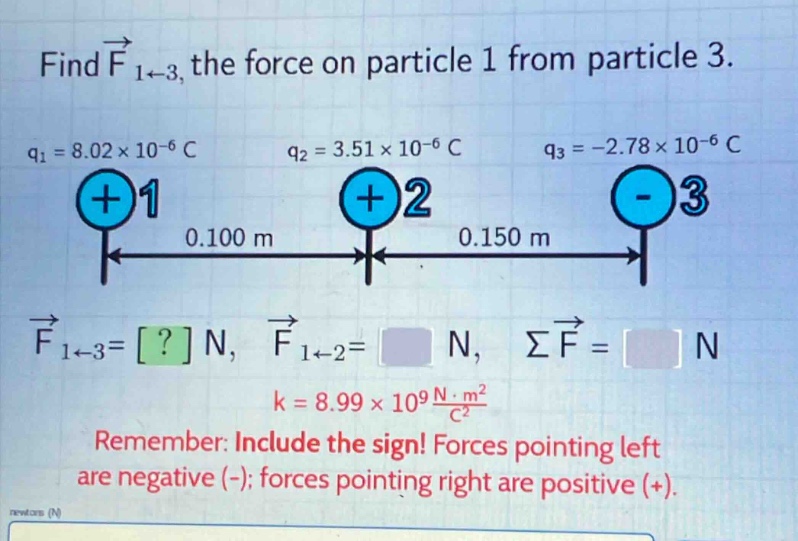
find $vec{f}_{1leftarrow3}$, the force on particle 1 from particle 3.\n$q_1 = 8.02\times10^{-6} c$\n$q_2 = 3.51\times10^{-6} c$\n$q_3=-2.78\times10^{-6} c$\n$vec{f}_{1leftarrow3}=? n, vec{f}_{1leftarrow2}= n, sumvec{f}= n$\n$k = 8.99\times10^{9}\frac{ncdot m^{2}}{c^{2}}$\nremember: include the sign! forces pointing left are negative (-); forces pointing right are positive (+).
Answer
Explanation:
Step1: Apply Coulomb's law formula
The Coulomb's law is $F = k\frac{q_1q_2}{r^{2}}$, where $k = 8.99\times 10^{9}\frac{N\cdot m^{2}}{C^{2}}$, $q_1$ and $q_2$ are the charges, and $r$ is the distance between them. To find the force $\vec{F}_{1\leftarrow3}$ on particle 1 from particle 3, we have $q_1 = 8.02\times 10^{-6}C$, $q_3=- 2.78\times 10^{-6}C$ and $r=(0.100 + 0.150)m=0.250m$.
Step2: Calculate the force value
Substitute the values into the formula: [ \begin{align*} F_{1\leftarrow3}&=k\frac{q_1|q_3|}{r^{2}}\ &=8.99\times 10^{9}\frac{N\cdot m^{2}}{C^{2}}\times\frac{8.02\times 10^{-6}C\times2.78\times 10^{-6}C}{(0.250m)^{2}}\ &=8.99\times 10^{9}\times\frac{8.02\times2.78\times 10^{- 12}}{0.0625}\ &=8.99\times\frac{22.3056\times 10^{-3}}{0.0625}\ &=8.99\times0.3569\ &\approx3.21N \end{align*} ] Since particle 3 is negative - charged and particle 1 is positive - charged, the force on particle 1 from particle 3 is attractive, and the direction is to the right. So $\vec{F}_{1\leftarrow3}=3.21N$.
Answer:
$3.21$