finding resistance and current in a parallel circuit\nperform calculations using the circuit illustrated…
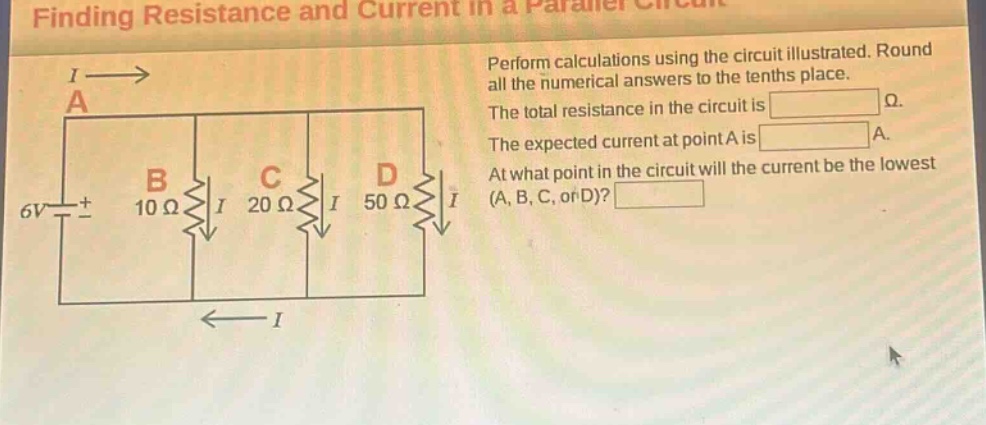
finding resistance and current in a parallel circuit\nperform calculations using the circuit illustrated. round all the numerical answers to the tenths place.\nthe total resistance in the circuit is ω.\nthe expected current at point a is a.\nat what point in the circuit will the current be the lowest (a, b, c, or d)?
Answer
Explanation:
Step1: Calculate total resistance
For resistors in parallel, the formula is $\frac{1}{R_{total}}=\frac{1}{R_1}+\frac{1}{R_2}+\frac{1}{R_3}$. Here, $R_1 = 10\Omega$, $R_2=20\Omega$, $R_3 = 50\Omega$. So $\frac{1}{R_{total}}=\frac{1}{10}+\frac{1}{20}+\frac{1}{50}=\frac{10 + 5+ 2}{100}=\frac{17}{100}$. Then $R_{total}=\frac{100}{17}\approx5.9\Omega$.
Step2: Calculate total current
Using Ohm's law $I=\frac{V}{R}$, where $V = 6V$ and $R = R_{total}\approx5.9\Omega$. So $I=\frac{6}{5.9}\approx1.0A$.
Step3: Analyze current at each point
In a parallel - circuit, the voltage across each branch is the same ($V = 6V$). For branch B, $I_B=\frac{V}{R_B}=\frac{6}{10}=0.6A$; for branch C, $I_C=\frac{V}{R_C}=\frac{6}{20}=0.3A$; for branch D, $I_D=\frac{V}{R_D}=\frac{6}{50}=0.12A$. The current is lowest at point D.
Answer:
The total resistance in the circuit is $5.9\Omega$. The expected current at point A is $1.0A$. At point D the current will be the lowest.