there is a finite amount of hydrogen in the core of the sun. as more hydrogen is converted into helium, the…
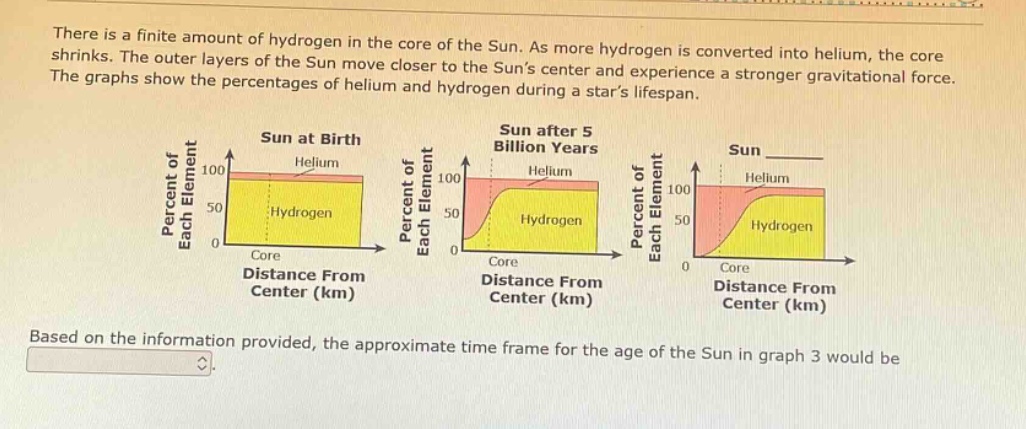
there is a finite amount of hydrogen in the core of the sun. as more hydrogen is converted into helium, the core shrinks. the outer layers of the sun move closer to the suns center and experience a stronger gravitational force. the graphs show the percentages of helium and hydrogen during a stars lifespan. based on the information provided, the approximate time frame for the age of the sun in graph 3 would be
Answer
Explanation:
Step1: Analyze the trend
As time passes, hydrogen in the Sun's core is converted to helium, and the amount of hydrogen decreases while helium increases. In the first graph (Sun at birth), hydrogen is at a high - percentage and helium is at a low percentage in the core. In the second graph (Sun after 5 billion years), there is a noticeable increase in helium and decrease in hydrogen in the core.
Step2: Estimate for graph 3
Since the trend shows continuous conversion of hydrogen to helium over time, and graph 3 has an even higher percentage of helium and lower percentage of hydrogen compared to graph 2, it represents a time later than 5 billion years. A reasonable estimate could be around 10 billion years as the Sun will continue to fuse hydrogen into helium over long periods.
Answer:
Around 10 billion years