a firework is launched into the air from ground level with an initial velocity of 128 ft/s. if acceleration…
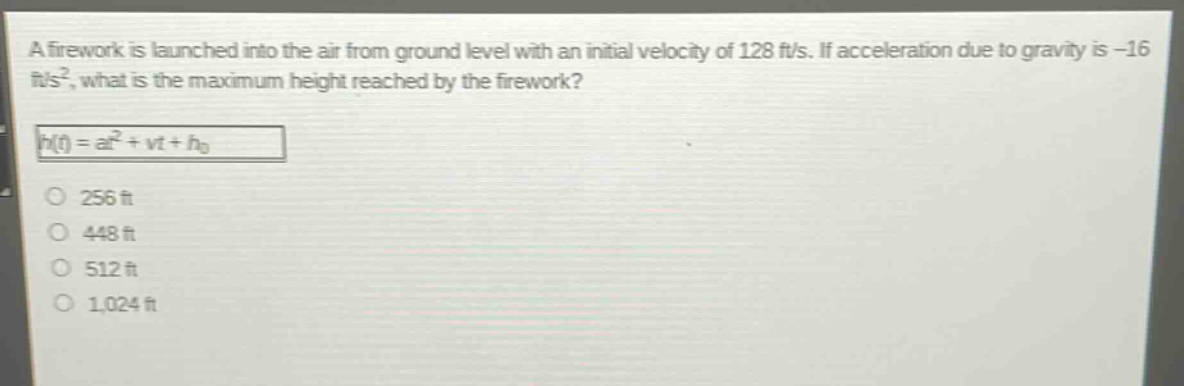
a firework is launched into the air from ground level with an initial velocity of 128 ft/s. if acceleration due to gravity is -16 ft/s², what is the maximum height reached by the firework?\nh(t) = at² + vt + h₀\n256 ft\n448 ft\n512 ft\n1,024 ft
Answer
Explanation:
Step1: Identify the values
We know that $a=- 16$ (acceleration), $v = 128$ (initial - velocity), and $h_0=0$ (initial - height as it starts from ground level). So the height - function is $h(t)=-16t^{2}+128t + 0=-16t^{2}+128t$.
Step2: Find the time at which the maximum height occurs
The time $t$ at which the maximum of a quadratic function $y = ax^{2}+bx + c$ occurs is given by $t=-\frac{b}{2a}$. For $h(t)=-16t^{2}+128t$, $a=-16$ and $b = 128$. Then $t=-\frac{128}{2\times(-16)}=\frac{-128}{-32}=4$ seconds.
Step3: Calculate the maximum height
Substitute $t = 4$ into the height - function $h(t)=-16t^{2}+128t$. So $h(4)=-16\times4^{2}+128\times4=-16\times16 + 512=-256+512 = 256$ feet.
Answer:
256 ft