all of the following contain condition statements, except\n○ the overhead service entrance conductors are…
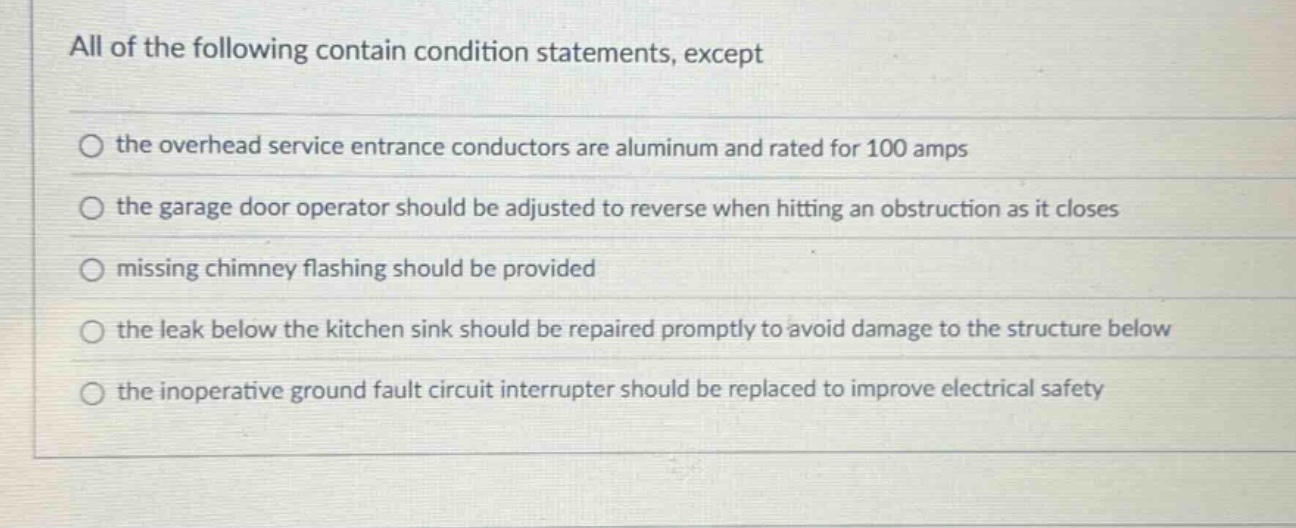
all of the following contain condition statements, except\n○ the overhead service entrance conductors are aluminum and rated for 100 amps\n○ the garage door operator should be adjusted to reverse when hitting an obstruction as it closes\n○ missing chimney flashing should be provided\n○ the leak below the kitchen sink should be repaired promptly to avoid damage to the structure below\n○ the inoperative ground fault circuit interrupter should be replaced to improve electrical safety
Answer
Brief Explanations:
A condition statement has an "if - then" or equivalent logical structure. The first option just states a fact about conductors. The second has "when hitting an obstruction" (condition). The third is a simple statement without a condition. The fourth has "to avoid damage" (implied condition). The fifth has "to improve electrical safety" (implied condition). The first and third do not have explicit condition statements, but the first is a description of a property, while the third is a simple directive without a condition - based trigger.
Answer:
the overhead service entrance conductors are aluminum and rated for 100 amps, missing chimney flashing should be provided