7. which of the following is a good maintenance practice for a steel rule?\na. storing it next to a…
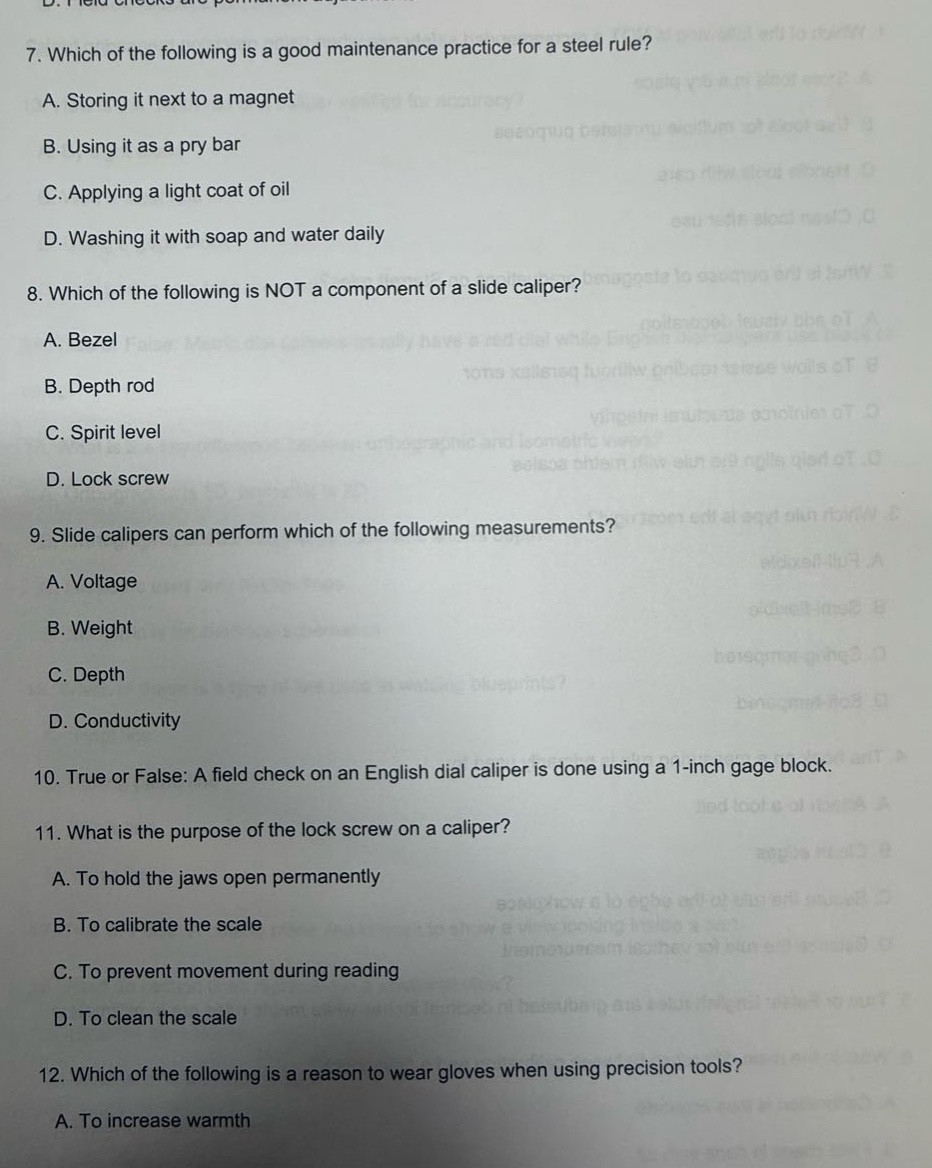
7. which of the following is a good maintenance practice for a steel rule?\na. storing it next to a magnet\nb. using it as a pry bar\nc. applying a light coat of oil\nd. washing it with soap and water daily\n8. which of the following is not a component of a slide caliper?\na. bezel\nb. depth rod\nc. spirit level\nd. lock screw\n9. slide calipers can perform which of the following measurements?\na. voltage\nb. weight\nc. depth\nd. conductivity\n10. true or false: a field check on an english dial caliper is done using a 1 - inch gage block.\n11. what is the purpose of the lock screw on a caliper?\na. to hold the jaws open permanently\nb. to calibrate the scale\nc. to prevent movement during reading\nd. to clean the scale\n12. which of the following is a reason to wear gloves when using precision tools?\na. to increase warmth
Answer
Answer:
- C. Applying a light coat of oil
- C. Spirit level
- C. Depth
- True
- C. To prevent movement during reading
- No options provided in the question for 12.
Brief Explanations:
- Oil prevents rust on steel rules. Storing near a magnet can magnetize it, using as a pry - bar can damage it, and daily soap - water wash can cause rust.
- A slide caliper typically has jaws, a depth rod, and a lock screw, but not a spirit level.
- Slide calipers are used for linear measurements like length, diameter, and depth, not for voltage, weight, or conductivity.
- A 1 - inch gage block is commonly used for field checks on English dial calipers.
- The lock screw on a caliper locks the jaws in place to prevent movement while taking a reading.