a force of 60 n is used to stretch two springs that are initially the same length. spring a has a spring…
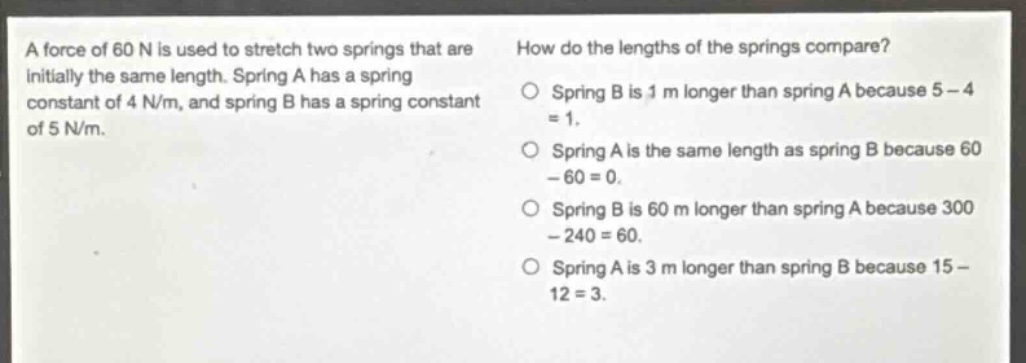
a force of 60 n is used to stretch two springs that are initially the same length. spring a has a spring constant of 4 n/m, and spring b has a spring constant of 5 n/m. how do the lengths of the springs compare? spring b is 1 m longer than spring a because 5 - 4 = 1. spring a is the same length as spring b because 60 - 60 = 0. spring b is 60 m longer than spring a because 300 - 240 = 60. spring a is 3 m longer than spring b because 15 - 12 = 3.
Answer
Explanation:
Step1: Recall Hooke's Law
$F = kx$, where $F$ is force, $k$ is spring - constant, and $x$ is the displacement from equilibrium.
Step2: Calculate the displacement of spring A
Given $F = 60N$ and $k_A=4N/m$. Rearranging $F = kx$ for $x$, we get $x_A=\frac{F}{k_A}$. Substituting values, $x_A=\frac{60}{4}=15m$.
Step3: Calculate the displacement of spring B
Given $F = 60N$ and $k_B = 5N/m$. Rearranging $F = kx$ for $x$, we get $x_B=\frac{F}{k_B}$. Substituting values, $x_B=\frac{60}{5}=12m$.
Step4: Compare the displacements
The difference in lengths (displacements) is $x_A - x_B=15 - 12 = 3m$. So spring A is 3m longer than spring B.
Answer:
Spring A is 3 m longer than spring B because 15 - 12 = 3.