the force exerted by a pulley is the sum of the tension and the force of gravity. since a pulley is used to…
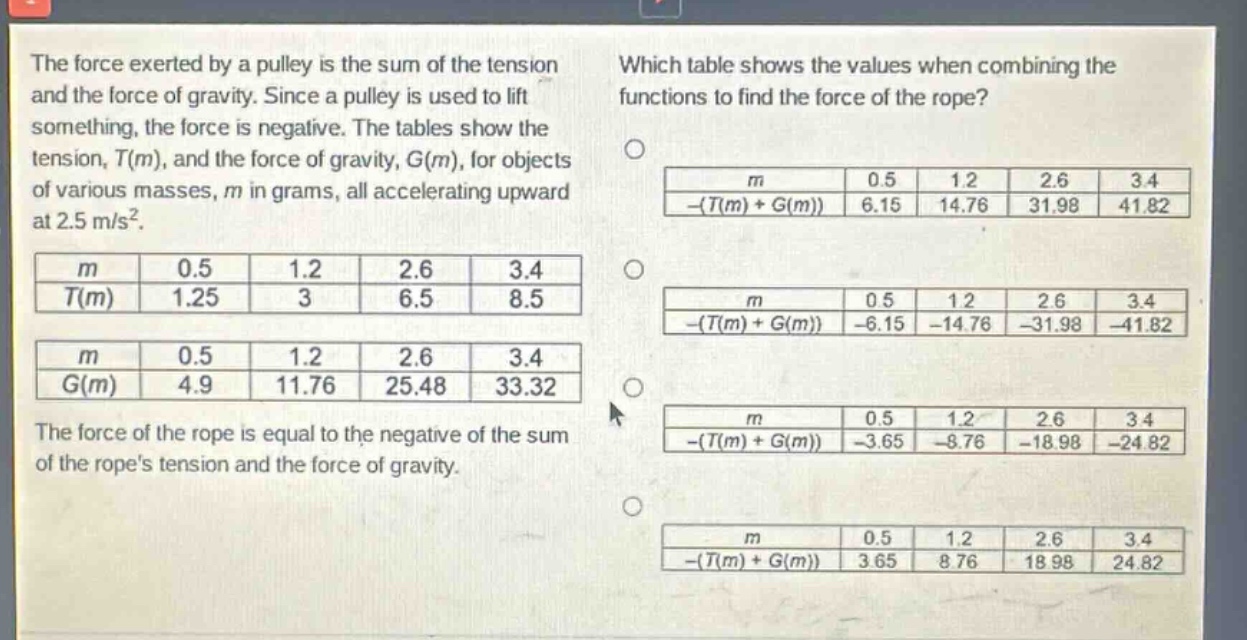
the force exerted by a pulley is the sum of the tension and the force of gravity. since a pulley is used to lift something, the force is negative. the tables show the tension, $t(m)$, and the force of gravity, $g(m)$, for objects of various masses, $m$ in grams, all accelerating upward at 2.5 m/s².\n|$m$|0.5|1.2|2.6|3.4|\n|$t(m)$|1.25|3|6.5|8.5|\n|$m$|0.5|1.2|2.6|3.4|\n|$g(m)$|4.9|11.76|25.48|33.32|\nthe force of the rope is equal to the negative of the sum of the ropes tension and the force of gravity.\nwhich table shows the values when combining the functions to find the force of the rope?\n|$m$|0.5|1.2|2.6|3.4|\n|$-(t(m)+g(m))$|6.15|14.76|31.98|41.82|\n|$m$|0.5|1.2|2.6|3.4|\n|$-(t(m)+g(m))$|-6.15|-14.76|-31.98|-41.82|\n|$m$|0.5|1.2|2.6|3.4|\n|$-(t(m)+g(m))$|-3.65|-8.76|-18.98|-24.82|\n|$m$|0.5|1.2|2.6|3.4|\n|$-(t(m)+g(m))$|3.65|8.76|18.98|24.82|
Answer
Explanation:
Step1: Calculate sum for (m = 0.5)
(-(T(0.5)+G(0.5))=-(1.25 + 4.9)=-6.15)
Step2: Calculate sum for (m = 1.2)
(-(T(1.2)+G(1.2))=-(3 + 11.76)=-14.76)
Step3: Calculate sum for (m = 2.6)
(-(T(2.6)+G(2.6))=-(6.5+25.48)=-31.98)
Step4: Calculate sum for (m = 3.4)
(-(T(3.4)+G(3.4))=-(8.5 + 33.32)=-41.82)
Answer:
The second - table (with values (-6.15,-14.76,-31.98,-41.82))