the force of gravity between two objects is given by fg = -gm1m2 / r2, where g is the gravitational…
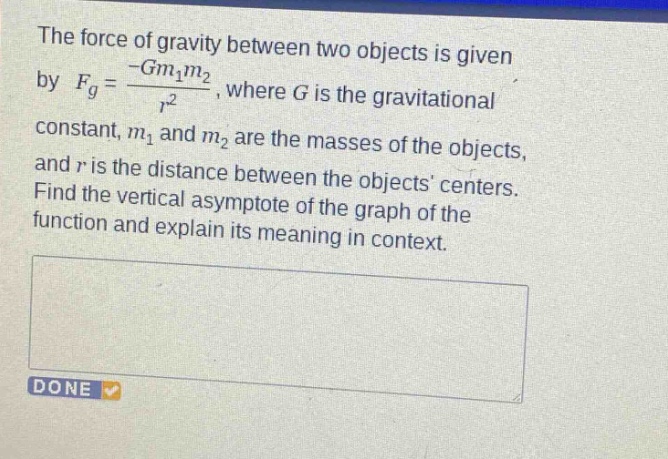
the force of gravity between two objects is given by fg = -gm1m2 / r2, where g is the gravitational constant, m1 and m2 are the masses of the objects, and r is the distance between the objects centers. find the vertical asymptote of the graph of the function and explain its meaning in context.
Answer
Answer:
The vertical asymptote is $r = 0$.
Explanation:
Step1: Recall vertical - asymptote definition
For a rational function $y=\frac{f(x)}{g(x)}$, vertical asymptotes occur where $g(x)=0$.
Step2: Identify the denominator in the gravity - force function
In $F_g=\frac{-Gm_1m_2}{r^2}$, the denominator is $r^2$.
Step3: Solve for the vertical asymptote
Set $r^2 = 0$. Solving gives $r = 0$.
Step4: Interpret in context
Physically, $r = 0$ means the two objects are at the same location. The force of gravity becomes infinitely large as the distance between the centers of the two objects approaches zero, which is a non - physical situation in the real world as objects cannot occupy the exact same space and quantum and other effects would come into play at extremely small distances.