the force of gravity between two objects is given by (f_g=\frac{-gm_1m_2}{r^2}), where (g) is the…
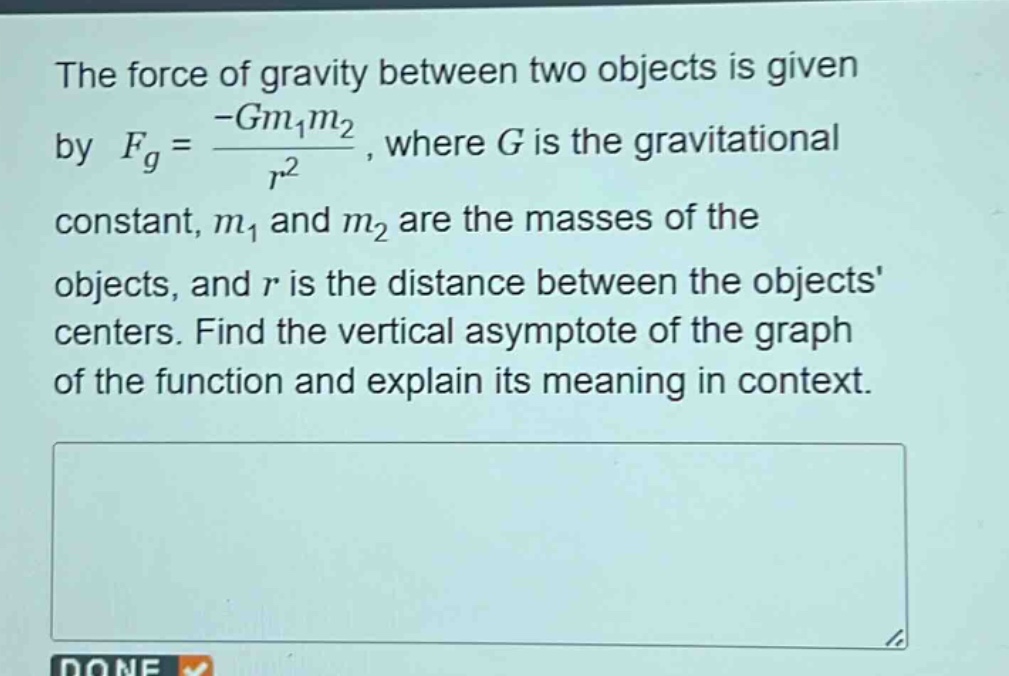
the force of gravity between two objects is given by (f_g=\frac{-gm_1m_2}{r^2}), where (g) is the gravitational constant, (m_1) and (m_2) are the masses of the objects, and (r) is the distance between the objects centers. find the vertical asymptote of the graph of the function and explain its meaning in context.
Answer
Explanation:
Step1: Recall vertical - asymptote concept
For a rational function $y = \frac{f(x)}{g(x)}$, vertical asymptotes occur where $g(x)=0$. In the function $F_g=\frac{-Gm_1m_2}{r^2}$, $f(r)=-Gm_1m_2$ and $g(r)=r^2$.
Step2: Solve for $r$ when $g(r) = 0$
Set $r^2 = 0$. Solving the equation $r^2=0$ gives $r = 0$.
Step3: Interpret in context
In the context of the gravitational - force formula, as the distance $r$ between the centers of the two objects approaches $0$, the magnitude of the gravitational force $F_g$ approaches infinity. This is a theoretical situation because in reality, objects have non - zero size and cannot be point masses with a distance of exactly $0$ between their centers.
Answer:
The vertical asymptote is $r = 0$. It means that as the distance between the centers of the two objects approaches $0$, the magnitude of the gravitational force between them approaches infinity.