four different pairs of objects are modeled below. all of the objects are spheres made of the same solid…
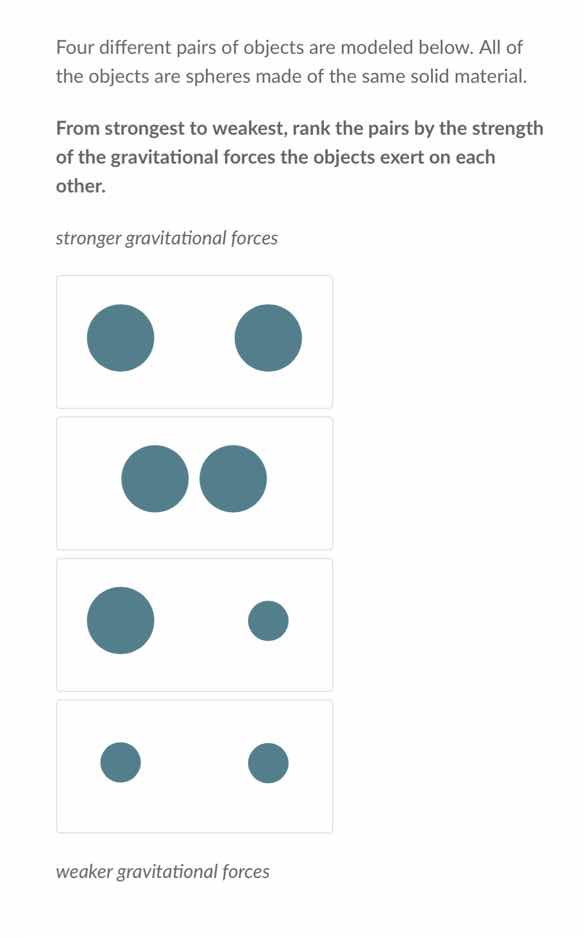
four different pairs of objects are modeled below. all of the objects are spheres made of the same solid material. from strongest to weakest, rank the pairs by the strength of the gravitational forces the objects exert on each other. stronger gravitational forces weaker gravitational forces
Answer
Explanation:
The gravitational force between two objects is given by Newton's law of universal gravitation: ( F = G\frac{m_1m_2}{r^2} ), where ( G ) is the gravitational constant, ( m_1 ) and ( m_2 ) are the masses of the two objects, and ( r ) is the distance between their centers. All objects are spheres of the same solid material, so mass is proportional to volume (( V=\frac{4}{3}\pi r^3 )), meaning larger spheres have more mass.
Step 1: Analyze Mass and Distance for Each Pair
- Pair 2 (middle - two large spheres close): Both spheres are large (high mass) and the distance ( r ) between them is small.
- Pair 1 (top - two large spheres far): Both spheres are large (high mass) but the distance ( r ) between them is larger than in Pair 2.
- **Pair 3 (third - one large, one small, far? Wait, no, let's re - examine the images. Wait, the third pair: one large sphere and one small sphere, distance? Wait, the second pair has two large spheres very close. The first pair has two large spheres with some distance. The third pair: one large, one small, distance? Wait, the fourth pair: two small spheres, distance? Wait, let's list the pairs:
- Top pair: two large spheres, distance ( r_1 )
- Second pair: two large spheres, distance ( r_2 ), ( r_2<r_1 )
- Third pair: one large, one small sphere, distance ( r_3 ) (let's assume ( r_3 ) is similar to ( r_1 ) or? Wait, no, the second pair has the two large spheres very close. So mass: for a sphere, mass ( m=\rho V=\rho\frac{4}{3}\pi R^3 ), where ( \rho ) is density (same for all). So a large sphere has more mass than a small one.
- Pair 2 (two large, close): ( m_1 = m_2 = M ) (large mass), ( r = d_2 ) (small distance)
- Pair 1 (two large, far): ( m_1 = m_2 = M ), ( r = d_1 ), ( d_1>d_2 )
- **Pair 3 (one large, one small, distance? Let's see the third pair: one big, one small, distance. Let's say the big sphere has mass ( M ), small has mass ( m ) (( m < M )), distance ( d_3 ).
- **Pair 4 (two small, distance ( d_4 )): ( m_1 = m_2 = m ) (small mass), ( r = d_4 )
Step 2: Compare Forces Using ( F = G\frac{m_1m_2}{r^2} )
- Force on Pair 2 (( F_2 )): ( m_1 = m_2 = M ), ( r = d_2 ) (small). So ( F_2=G\frac{M\times M}{d_2^2} )
- Force on Pair 1 (( F_1 )): ( m_1 = m_2 = M ), ( r = d_1 ) (( d_1>d_2 )). So ( F_1 = G\frac{M\times M}{d_1^2} ), and since ( d_1>d_2 ), ( F_1<F_2 )
- Force on Pair 3 (( F_3 )): ( m_1 = M ), ( m_2 = m ) (( m < M )), ( r = d_3 ) (let's assume ( d_3 ) is similar to ( d_1 ) or maybe a bit more? Wait, no, the third pair: one big, one small. The product ( M\times m ) is less than ( M\times M ) (since ( m < M )). So even if ( d_3 = d_1 ), ( F_3=G\frac{M\times m}{d_3^2}<G\frac{M\times M}{d_1^2}=F_1 ) (because ( M\times m < M\times M ) and ( d_3 ) is at least as big as ( d_1 ) or? Wait, maybe the distance in pair 3 is similar to pair 1.
- Force on Pair 4 (( F_4 )): ( m_1 = m_2 = m ), ( r = d_4 ). So ( F_4=G\frac{m\times m}{d_4^2} ), which is much less than ( F_3 ) (since ( m\times m < M\times m )) and less than ( F_1,F_2 )
Step 3: Rank by Force Strength
The force is proportional to the product of the masses and inversely proportional to the square of the distance. So:
- Pair 2 (two large, close): Highest force (large mass product, small distance)
- Pair 1 (two large, far): Next (large mass product, larger distance than Pair 2)
- Pair 3 (one large, one small): Next (mass product less than Pair 1, distance similar or more? Wait, maybe I made a mistake. Wait, the third pair: one big, one small. Let's re - evaluate. Wait, the second pair has two large spheres very close. So ( F\propto\frac{m_1m_2}{r^2} ).
For Pair 2: ( m_1 = m_2 = M ), ( r = r_2 )
Pair 1: ( m_1 = m_2 = M ), ( r = r_1 ), ( r_1>r_2 ), so ( F_1=\frac{G M^2}{r_1^2} ), ( F_2=\frac{G M^2}{r_2^2} ), so ( F_2 > F_1 )
Pair 3: ( m_1 = M ), ( m_2 = m ) ( ( m < M ) ), ( r = r_3 ). Let's assume ( r_3\approx r_1 ). Then ( F_3=\frac{G M m}{r_3^2} ). Since ( M m < M^2 ) and ( r_3\approx r_1 ), ( F_3 < F_1 )
Pair 4: ( m_1 = m_2 = m ), ( r = r_4 ). ( F_4=\frac{G m^2}{r_4^2} ), which is less than ( F_3 ) (since ( m^2 < M m ))
So the order from strongest to weakest is:
- Pair 2 (two large spheres close together)
- Pair 1 (two large spheres far apart)
- Pair 3 (one large, one small sphere)
- Pair 4 (two small spheres)
Wait, but let's check the images again. The second pair (the one with two large spheres very close) has the highest force because both mass (large) and distance (small) favor a large force. Then the first pair (two large spheres, more distance) has less force than the second but more than the third (one large, one small) because the product of masses in the first pair (large×large) is more than in the third (large×small). Then the third pair has more force than the fourth (small×small) because large×small > small×small.
So the ranking from strongest to weakest is:
Second pair (two large, close) → First pair (two large, far) → Third pair (one large, one small) → Fourth pair (two small)
Answer:
The order from strongest to weakest gravitational force is: the pair with two large spheres close together (second pair) > the pair with two large spheres far apart (first pair) > the pair with one large and one small sphere (third pair) > the pair with two small spheres (fourth pair). In terms of the given boxes (from top to bottom in the original image, the second pair is the one with two large spheres close, first pair is top, third is the one with one large and one small, fourth is bottom). So the ranking is:
- Second pair (two large spheres, close)
- First pair (two large spheres, far)
- Third pair (one large, one small)
- Fourth pair (two small spheres)
So when ranking from strongest to weakest, the order of the pairs (from top to bottom in the original problem's display) is:
Second pair (the one with two large spheres close) → First pair (two large spheres far) → Third pair (one large, one small) → Fourth pair (two small spheres)
If we label the pairs as:
Pair A: Top (two large, far)
Pair B: Second (two large, close)
Pair C: Third (one large, one small)
Pair D: Fourth (two small)
Then the order is B, A, C, D.