four waves are produced when a harp is strummed at four different times.\n|wave 1|wave 2|wave 3|wave…
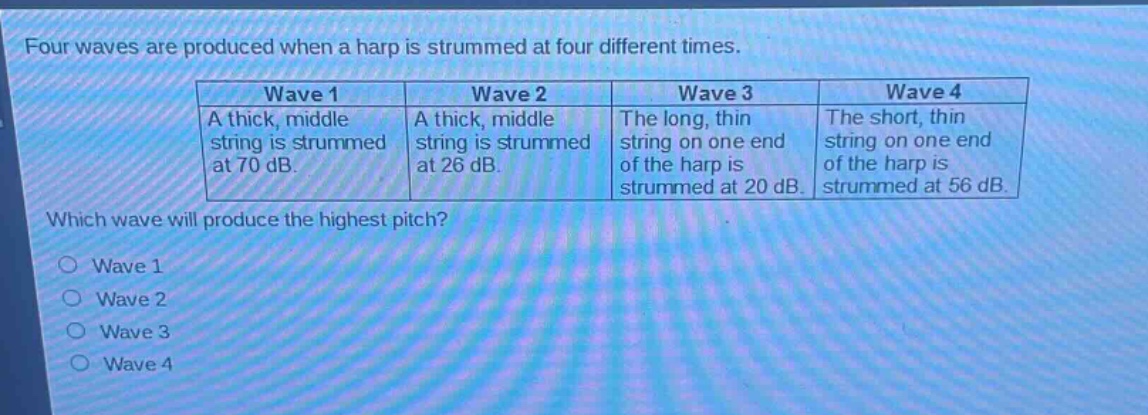
four waves are produced when a harp is strummed at four different times.\n|wave 1|wave 2|wave 3|wave 4|\n|--|--|--|--|\n|a thick, middle string is strummed at 70 db.|a thick, middle string is strummed at 26 db.|the long, thin string on one end of the harp is strummed at 20 db.|the short, thin string on one end of the harp is strummed at 56 db.|which wave will produce the highest pitch?\no wave 1\no wave 2\no wave 3\no wave 4
Answer
Brief Explanations:
The pitch of a vibrating string depends on its length and thickness. Shorter and thinner strings produce higher - pitched sounds. Wave 4 is from a short, thin string, while the other waves are from thicker or longer strings. The decibel (dB) level is related to loudness, not pitch.
Answer:
Wave 4