the function $f(t)=349.2(0.98)^t$ models the relationship between $t$, the time an oven spends cooling and…
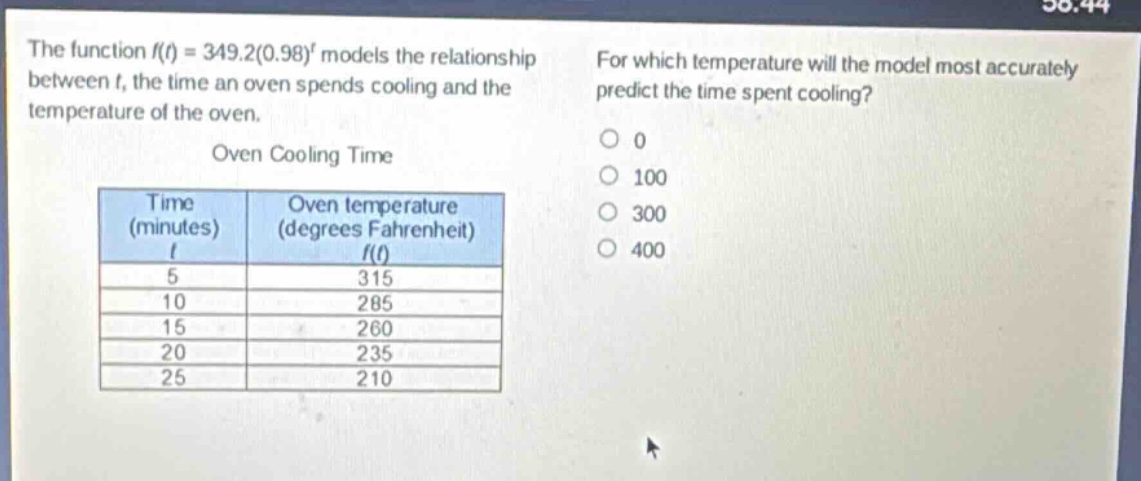
the function $f(t)=349.2(0.98)^t$ models the relationship between $t$, the time an oven spends cooling and the temperature of the oven.\noven cooling time\n| time (minutes) $t$ | oven temperature (degrees fahrenheit) $f(t)$ |\n| ---- | ---- |\n| 5 | 315 |\n| 10 | 285 |\n| 15 | 260 |\n| 20 | 235 |\n| 25 | 210 |\nfor which temperature will the model most accurately predict the time spent cooling?\n0\n100\n300\n400
Answer
Explanation:
Step1: Analyze the nature of the exponential - decay model
The function $f(t)=349.2(0.98)^t$ is an exponential - decay function. Exponential - decay models are most accurate when the data points follow the general trend of the model closely. We can assume that the model was derived from data in a certain range.
Step2: Observe the data in the table
Looking at the table of values, the oven temperatures range from 210 to 315 degrees Fahrenheit. The model is likely to be most accurate within the range of temperatures for which the data was collected or is representative.
Step3: Select the appropriate temperature
Among the options 0, 100, 300, and 400, the temperature of 300 is within the range of temperatures (210 - 315) that the data in the table represents.
Answer:
300