the function $f(t)=349.2(0.98)^t$ models the relationship between $t$, the time an oven spends cooling and…
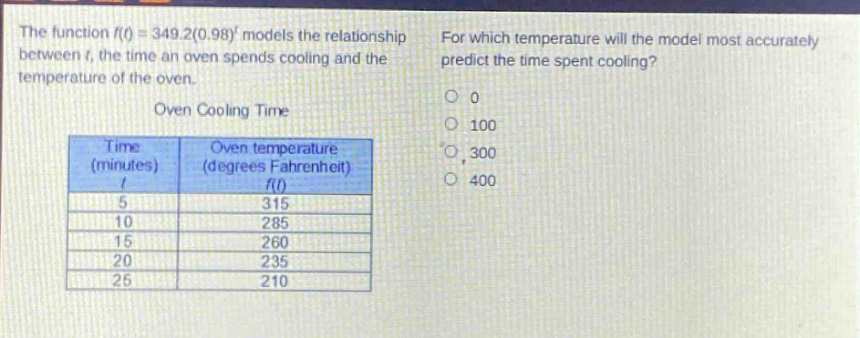
the function $f(t)=349.2(0.98)^t$ models the relationship between $t$, the time an oven spends cooling and the temperature of the oven.\noven cooling time\n| time (minutes) | oven temperature (degrees fahrenheit) |\n| ---- | ---- |\n| $t$ | $f(t)$ |\n| 5 | 315 |\n| 10 | 285 |\n| 15 | 260 |\n| 20 | 235 |\n| 25 | 210 |\nfor which temperature will the model most accurately predict the time spent cooling?\n0\n100\n300\n400
Answer
Explanation:
Step1: Analizar la función exponencial
La función $f(t)=349.2(0.98)^t$ es una función exponencial decreciente. A medida que $t$ aumenta, el valor de $f(t)$ disminuye.
Step2: Observar la tabla
En la tabla, vemos que a medida que el tiempo $t$ de enfriamiento aumenta, la temperatura del horno disminuye.
Step3: Considerar la tendencia
La función exponencial se ajustará mejor a los valores iniciales de la temperatura del horno, ya que la desviación entre los valores predichos por la función y los valores reales de la tabla será menor en los valores iniciales. Entre los valores dados, el valor más alto de temperatura (400) es el que más probablemente se ajustará mejor al modelo, ya que es más cercano al valor inicial de temperatura del horno antes de que empiece a enfriarse.
Answer:
400