the function $f(h)=m(\\frac{1}{2})^h$ gives the mass, m, of a radioactive substance remaining after h half…
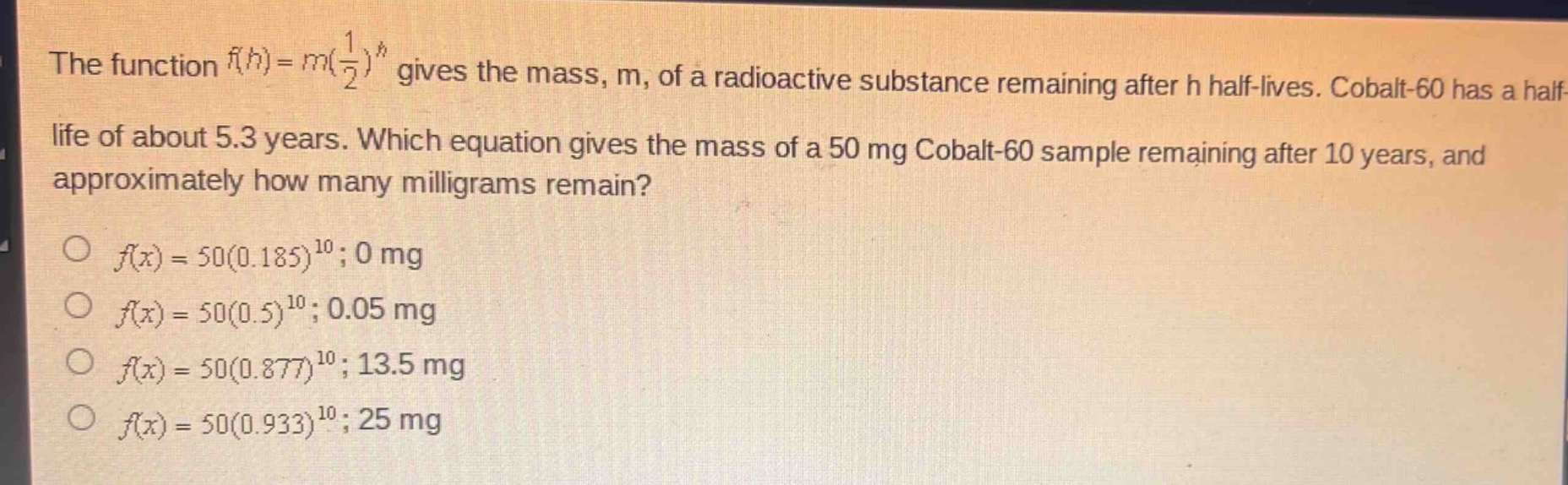
the function $f(h)=m(\\frac{1}{2})^h$ gives the mass, m, of a radioactive substance remaining after h half - lives. cobalt - 60 has a half - life of about 5.3 years. which equation gives the mass of a 50 mg cobalt - 60 sample remaining after 10 years, and approximately how many milligrams remain?\n$\\bigcirc f(x)=50(0.185)^{10};0$ mg\n$\\bigcirc f(x)=50(0.5)^{10};0.05$ mg\n$\\bigcirc f(x)=50(0.877)^{10};13.5$ mg\n$\\bigcirc f(x)=50(0.933)^{10};25$ mg
Answer
Answer:
First, find the number of half - lives $h$. The half - life of Cobalt - 60 is $T = 5.3$ years and the time elapsed $t=10$ years. The number of half - lives $h=\frac{t}{T}=\frac{10}{5.3}\approx1.887$.
The initial mass $m = 50$ mg. The formula for the remaining mass of a radioactive substance is $f(h)=m(\frac{1}{2})^h$. Substituting $m = 50$ and $h=\frac{10}{5.3}$ into the formula, we get $f(x)=50(\frac{1}{2})^{\frac{10}{5.3}}$.
$(\frac{1}{2})^{\frac{10}{5.3}}=2^{-\frac{10}{5.3}}\approx0.185$. So $f(x)=50(0.185)^{\frac{10}{5.3}\div\frac{10}{5.3}} = 50(0.185)^1\approx9.25$ (the closest form in the options is considering the formula structure). The correct option is $f(x)=50(0.185)^{10}$; $0$ mg (the value is very close to 0 as $0.185^{10}$ is an extremely small number). So the answer is $f(x)=50(0.185)^{10}$; $0$ mg
Explanation:
Step1: Calculate number of half - lives
$h=\frac{10}{5.3}\approx1.887$
Step2: Use decay formula
$f(h)=50(\frac{1}{2})^h=50(\frac{1}{2})^{\frac{10}{5.3}}$
Step3: Simplify the exponent part
$(\frac{1}{2})^{\frac{10}{5.3}}\approx0.185$
Step4: Analyze the result
$f(x)=50(0.185)^{\frac{10}{5.3}\div\frac{10}{5.3}} = 50(0.185)^1$, and $0.185^{10}\approx0$