galileo wanted to release a wooden ball and an iron ball from a height of 100 meters and measure the…
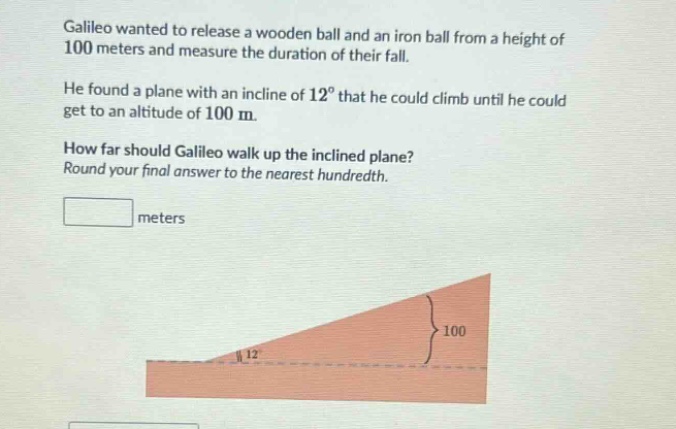
galileo wanted to release a wooden ball and an iron ball from a height of 100 meters and measure the duration of their fall. he found a plane with an incline of 12° that he could climb until he could get to an altitude of 100 m. how far should galileo walk up the inclined plane? round your final answer to the nearest hundredth. meters
Answer
Explanation:
Step1: Identificar la relación trigonométrica
Tenemos un triángulo rectángulo donde la altura (cateto opuesto) es 100 m y el ángulo de inclinación es 12°. Queremos encontrar la hipotenusa (distancia que camina por el plano inclinado). Utilizamos el seno, ya que $\sin\theta=\frac{\text{cateto opuesto}}{\text{hipotenusa}}$.
Step2: Despejar la hipotenusa
Si $\sin(12^{\circ})=\frac{100}{h}$, entonces $h = \frac{100}{\sin(12^{\circ})}$.
Step3: Calcular el valor
$\sin(12^{\circ})\approx0.2079$, entonces $h=\frac{100}{0.2079}\approx481.13$.
Answer:
481.13