a gas has an initial volume of 168 cm³ at a temperature of 255 k and a pressure of 1.6 atm. the pressure of…
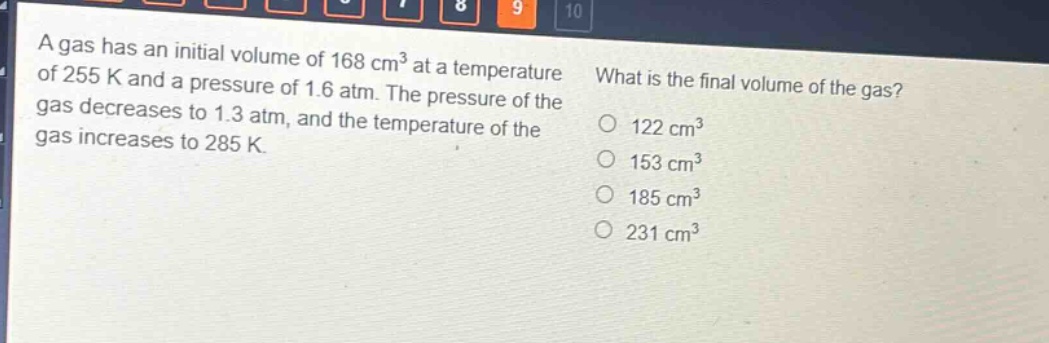
a gas has an initial volume of 168 cm³ at a temperature of 255 k and a pressure of 1.6 atm. the pressure of the gas decreases to 1.3 atm, and the temperature of the gas increases to 285 k. what is the final volume of the gas? 122 cm³ 153 cm³ 185 cm³ 231 cm³
Answer
Explanation:
Step1: Recall the combined - gas law formula
The combined - gas law is $\frac{P_1V_1}{T_1}=\frac{P_2V_2}{T_2}$, where $P_1$, $V_1$, $T_1$ are the initial pressure, volume and temperature respectively, and $P_2$, $V_2$, $T_2$ are the final pressure, volume and temperature respectively.
Step2: Identify the given values
$P_1 = 1.6$ atm, $V_1=168$ cm³, $T_1 = 255$ K, $P_2 = 1.3$ atm, $T_2=285$ K, and we need to find $V_2$.
Step3: Rearrange the combined - gas law formula for $V_2$
$V_2=\frac{P_1V_1T_2}{T_1P_2}$
Step4: Substitute the values into the formula
$V_2=\frac{1.6\times168\times285}{255\times1.3}$ First, calculate the numerator: $1.6\times168\times285 = 1.6\times47880=76608$. Then, calculate the denominator: $255\times1.3 = 331.5$. Finally, $V_2=\frac{76608}{331.5}=231$ cm³.
Answer:
$231$ cm³