the gravitational force between two objects is 2000 n. the mass of each object is reduced to one - third of…
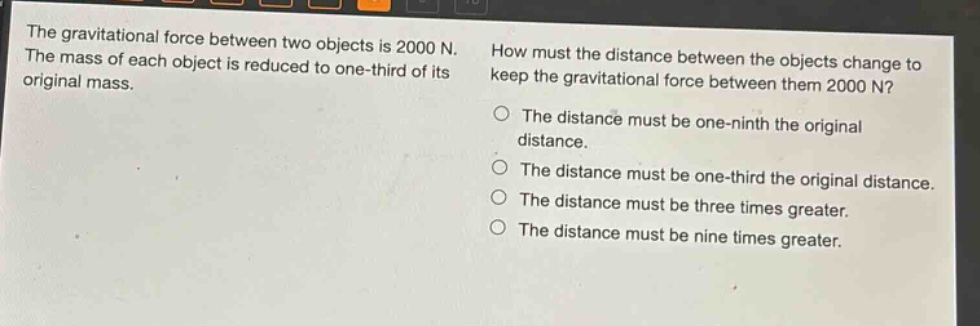
the gravitational force between two objects is 2000 n. the mass of each object is reduced to one - third of its original mass. how must the distance between the objects change to keep the gravitational force between them 2000 n? the distance must be one - ninth the original distance. the distance must be one - third the original distance. the distance must be three times greater. the distance must be nine times greater.
Answer
Explanation:
Step1: Recall gravitational - force formula
The gravitational - force formula is $F = G\frac{m_1m_2}{r^2}$, where $F$ is the gravitational force, $G$ is the gravitational constant, $m_1$ and $m_2$ are the masses of the two objects, and $r$ is the distance between them. Let the initial masses be $m_1$ and $m_2$, and the initial distance be $r_1$, so $F_1=G\frac{m_1m_2}{r_1^2}=2000$ N.
Step2: Consider the new - mass situation
The new masses are $m_1'=\frac{1}{3}m_1$ and $m_2'=\frac{1}{3}m_2$. Let the new distance be $r_2$. The new gravitational force $F_2 = G\frac{m_1'm_2'}{r_2^2}$. Substitute $m_1'$ and $m_2'$ into the formula: $F_2=G\frac{\frac{1}{3}m_1\times\frac{1}{3}m_2}{r_2^2}=G\frac{m_1m_2}{9r_2^2}$.
Step3: Set $F_2 = F_1$
Since $F_1 = F_2 = 2000$ N, we have $G\frac{m_1m_2}{r_1^2}=G\frac{m_1m_2}{9r_2^2}$. Canceling out $G$, $m_1$, and $m_2$ from both sides of the equation, we get $\frac{1}{r_1^2}=\frac{1}{9r_2^2}$. Cross - multiply to obtain $9r_2^2=r_1^2$, then $r_1 = 3r_2$. Or we can say $r_2=\frac{1}{3}r_1$.
Answer:
The distance must be one - third the original distance.