a group of students is investigating how some materials transfer charge when rubbed together. first, the…
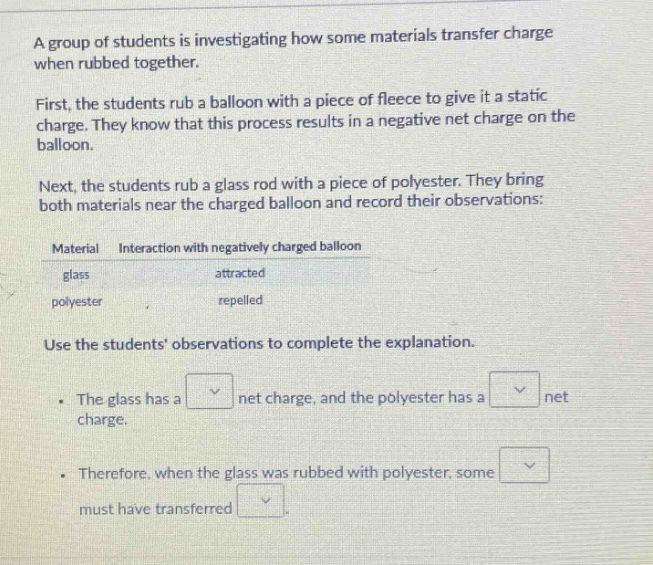
a group of students is investigating how some materials transfer charge when rubbed together. first, the students rub a balloon with a piece of fleece to give it a static charge. they know that this process results in a negative net charge on the balloon. next, the students rub a glass rod with a piece of polyester. they bring both materials near the charged balloon and record their observations: material interaction with negatively charged balloon glass attracted polyester repelled use the students observations to complete the explanation. the glass has a net charge, and the polyester has a net charge. therefore, when the glass was rubbed with polyester, some must have transferred
Answer
Explanation:
Step1: Recall charge - interaction rules
Opposite charges attract and like charges repel.
Step2: Analyze glass - balloon interaction
The glass is attracted to the negatively - charged balloon. So, the glass has a positive net charge.
Step3: Analyze polyester - balloon interaction
The polyester is repelled by the negatively - charged balloon. So, the polyester has a negative net charge.
Step4: Determine charge transfer
When the glass was rubbed with polyester, some electrons must have transferred from the glass to the polyester. Electrons are negatively - charged particles, and when they move from one material to another, it changes the net charge of the materials.
Answer:
- The glass has a positive net charge, and the polyester has a negative net charge.
- Therefore, when the glass was rubbed with polyester, some electrons must have transferred from the glass to the polyester.