the half - life of palladium - 100 is 4 days. after 16 days a sample of palladium - 100 has been reduced to…
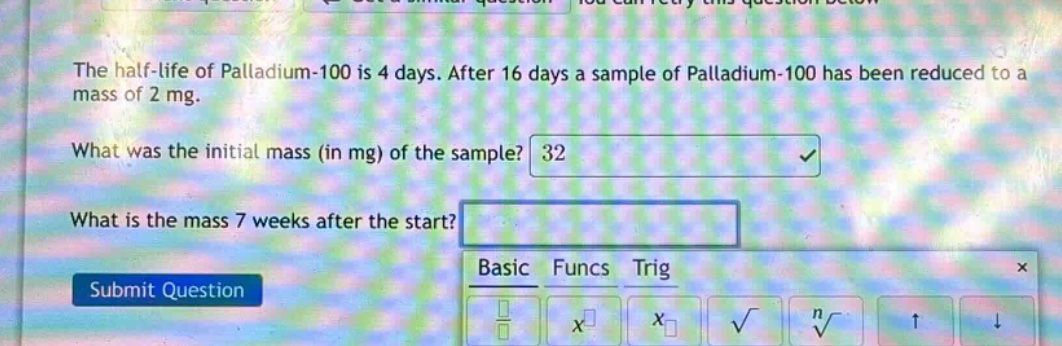
the half - life of palladium - 100 is 4 days. after 16 days a sample of palladium - 100 has been reduced to a mass of 2 mg. what was the initial mass (in mg) of the sample? what is the mass 7 weeks after the start?
Answer
Explanation:
Step1: Determine number of half - lives
The half - life of Palladium - 100 is $t_{1/2}=4$ days. 7 weeks is $7\times7 = 49$ days. The number of half - lives $n=\frac{49}{4}=12.25$.
Step2: Find initial mass formula
The formula for radioactive decay is $m = m_0(\frac{1}{2})^n$, where $m$ is the final mass, $m_0$ is the initial mass, and $n$ is the number of half - lives. We know from the first part that when $n=\frac{16}{4}=4$ and $m = 2$ mg, we can find $m_0$. Using $m = m_0(\frac{1}{2})^n$, we substitute $m = 2$, $n = 4$ and solve for $m_0$: $2=m_0(\frac{1}{2})^4$, so $m_0=2\times2^4=32$ mg.
Step3: Calculate final mass
Now we use the formula $m = m_0(\frac{1}{2})^n$ with $m_0 = 32$ mg and $n = 12.25$. $m=32\times(\frac{1}{2})^{12.25}=32\times2^{- 12.25}$. $2^{-12.25}=\frac{1}{2^{12.25}}$, and $2^{12.25}=2^{12}\times2^{0.25}$. $2^{12}=4096$, $2^{0.25}=\sqrt[4]{2}\approx1.189$. So $2^{12.25}\approx4096\times1.189 = 4860.144$. Then $m=\frac{32}{4860.144}\approx0.0066$ mg.
Answer:
$0.0066$ mg