the half - life of a radioactive element is five years. a scientist has 18 grams of the element. the…
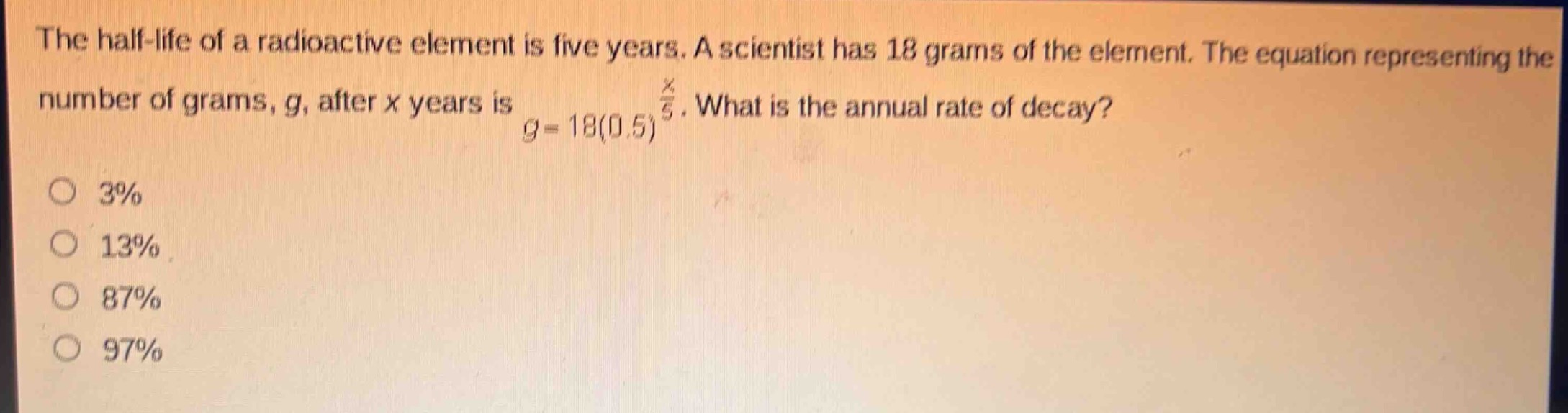
the half - life of a radioactive element is five years. a scientist has 18 grams of the element. the equation representing the number of grams, g, after x years is $g = 18(0.5)^{\frac{x}{5}}$. what is the annual rate of decay?\n3%\n13%\n87%\n97%
Answer
Answer:
B. 13%
Explanation:
Step1: Recall decay - formula form
The general form of an exponential - decay formula is $g = g_0(1 - r)^x$, where $g_0$ is the initial amount, $r$ is the rate of decay, and $x$ is the time. We are given $g = 18(0.5)^{\frac{x}{5}}$. Let's rewrite it in the general form.
Let $y=\frac{x}{5}$, then $x = 5y$. The equation becomes $g = 18(0.5)^{y}$. When $y = 1$ (i.e., $x = 5$ years), the amount is halved.
We want to find the decay rate for $x = 1$ year. Let the annual decay rate be $r$. Then $g = g_0(1 - r)^x$.
If we start with $g_0=18$, after $x = 1$ year, $g = 18(0.5)^{\frac{1}{5}}$.
We know that $g = g_0(1 - r)^x$, so $18(0.5)^{\frac{1}{5}}=18(1 - r)^1$.
Step2: Solve for $r$
Divide both sides of the equation $18(0.5)^{\frac{1}{5}}=18(1 - r)$ by 18: $(0.5)^{\frac{1}{5}}=1 - r$.
Calculate $(0.5)^{\frac{1}{5}}=\sqrt[5]{0.5}\approx0.8706$.
Then $r = 1-(0.5)^{\frac{1}{5}}\approx1 - 0.8706 = 0.1294\approx13%$.