what happens when the electron moves from the first energy level to the second energy level?\nenergy is…
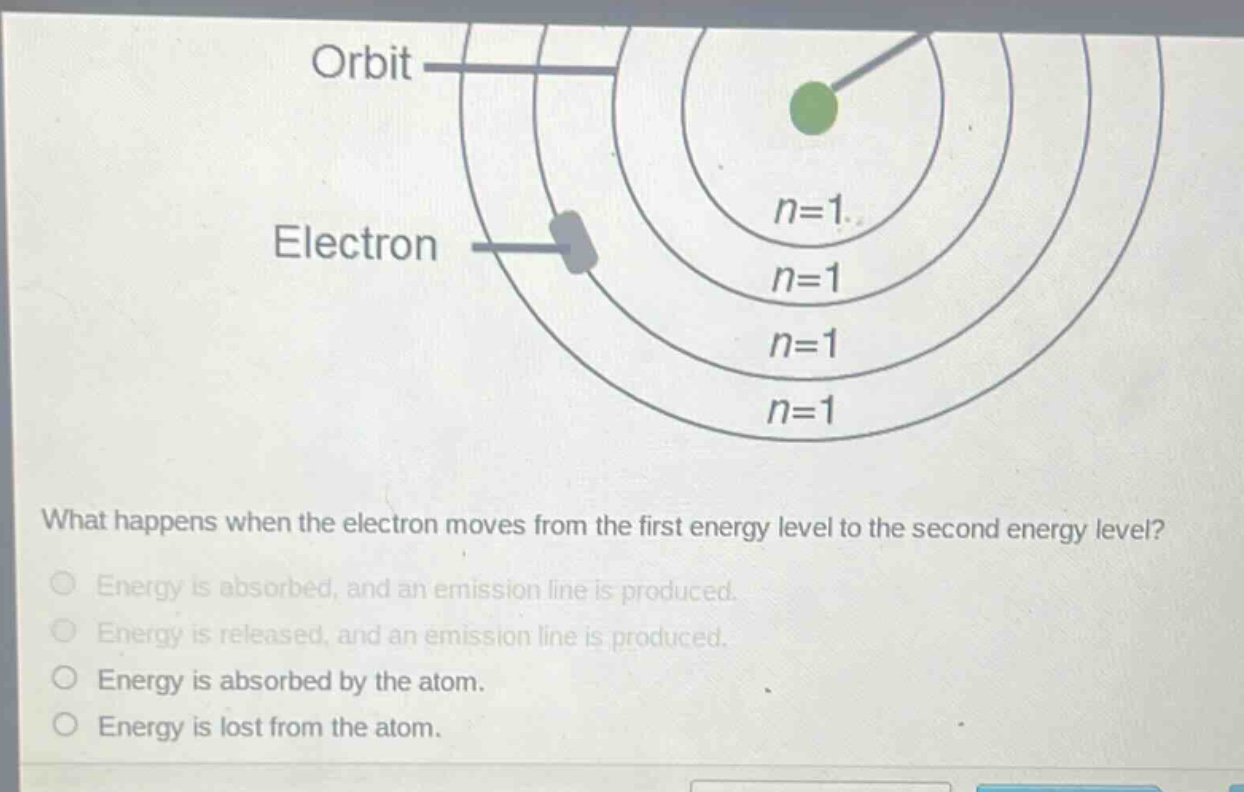
what happens when the electron moves from the first energy level to the second energy level?\nenergy is absorbed, and an emission line is produced.\nenergy is released, and an emission line is produced.\nenergy is absorbed by the atom.\nenergy is lost from the atom.
Answer
Answer:
Energy is absorbed by the atom.
Brief Explanations:
In the Bohr model of the atom, electrons occupy specific energy levels or orbits (n=1, n=2, n=3, etc.). The first energy level (n=1) is the lowest energy state (ground state). To move an electron from a lower energy level (like n=1) to a higher energy level (like n=2), the electron must gain energy. This energy is absorbed by the atom from an external source, such as a photon. Conversely, when an electron moves from a higher energy level to a lower one, it releases energy, often as a photon, which can produce an emission line. Therefore, moving from the first to the second energy level requires energy absorption.