what happens when you heat a liquid? the particles begin to slide past one another more and more quickly…
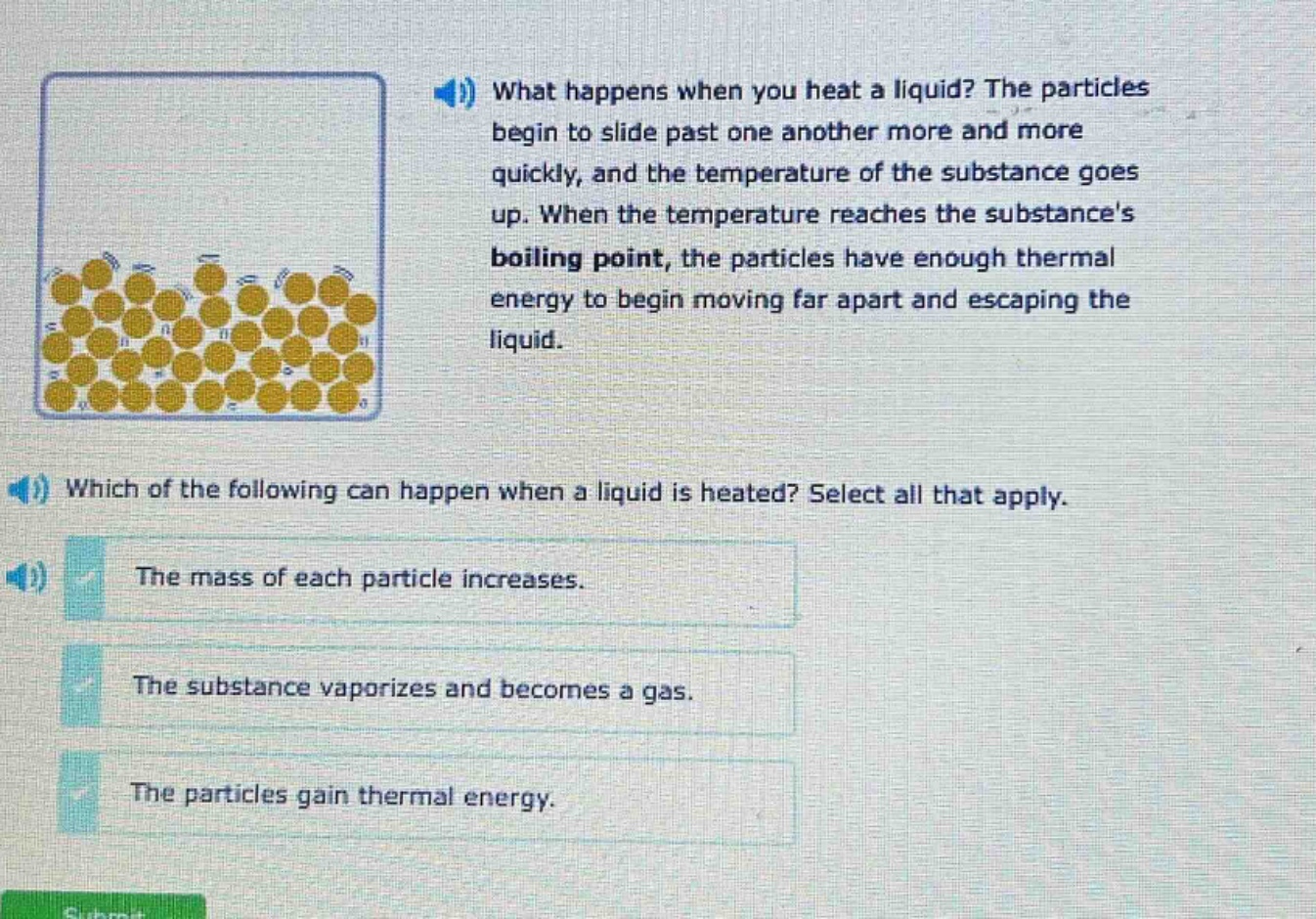
what happens when you heat a liquid? the particles begin to slide past one another more and more quickly, and the temperature of the substance goes up. when the temperature reaches the substances boiling point, the particles have enough thermal energy to begin moving far apart and escaping the liquid. which of the following can happen when a liquid is heated? select all that apply. the mass of each particle increases. the substance vaporizes and becomes a gas. the particles gain thermal energy.
Answer
Answer:
- The substance vaporizes and becomes a gas.
- The particles gain thermal energy.
Explanation:
Step1: Analyze particle - mass change
Heating a liquid does not change the mass of individual particles. Mass is a fundamental property of matter and is not affected by heating in normal circumstances. So "The mass of each particle increases" is incorrect.
Step2: Analyze vaporization
When the temperature of a liquid reaches its boiling - point, the liquid vaporizes and turns into a gas as the particles gain enough energy to escape the liquid phase. So "The substance vaporizes and becomes a gas" is correct.
Step3: Analyze thermal energy gain
When a liquid is heated, the heat energy is transferred to the particles, and they gain thermal energy, which causes them to move more quickly. So "The particles gain thermal energy" is correct.