when the height of the cylinder increased from 100 m to 1000 m, what happened to the amount of heat…
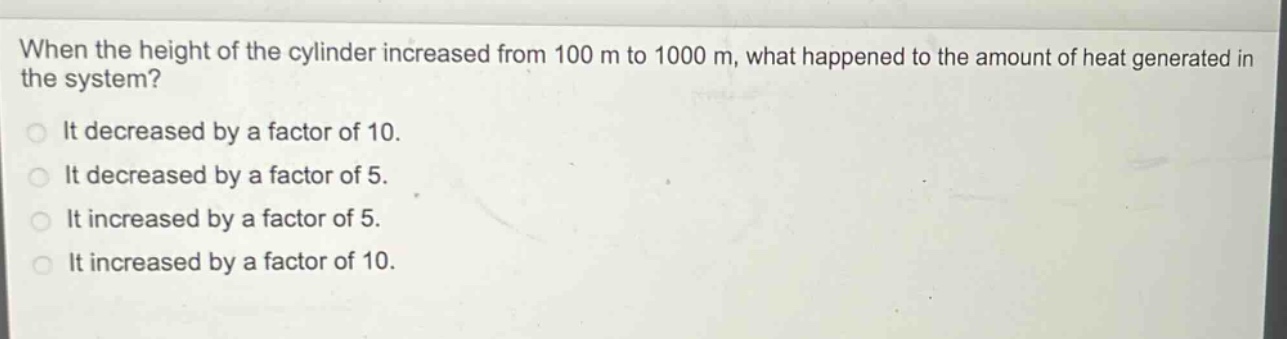
when the height of the cylinder increased from 100 m to 1000 m, what happened to the amount of heat generated in the system?\nit decreased by a factor of 10.\nit decreased by a factor of 5.\nit increased by a factor of 5.\nit increased by a factor of 10.
Answer
Explanation:
Step1: Assume heat - height relationship
Assume the amount of heat generated $Q$ is directly proportional to the height $h$ of the cylinder, i.e., $Q = kh$ where $k$ is a constant.
Step2: Calculate initial and final heat
Let the initial height $h_1=100$ m, so the initial heat $Q_1 = kh_1=100k$. The final height $h_2 = 1000$ m, so the final heat $Q_2=kh_2 = 1000k$.
Step3: Find the ratio of final to initial heat
Calculate $\frac{Q_2}{Q_1}=\frac{1000k}{100k}=10$.
Answer:
It increased by a factor of 10.