the height, h, in feet of a ball suspended from a spring as a function of time, t, in seconds can be modeled…
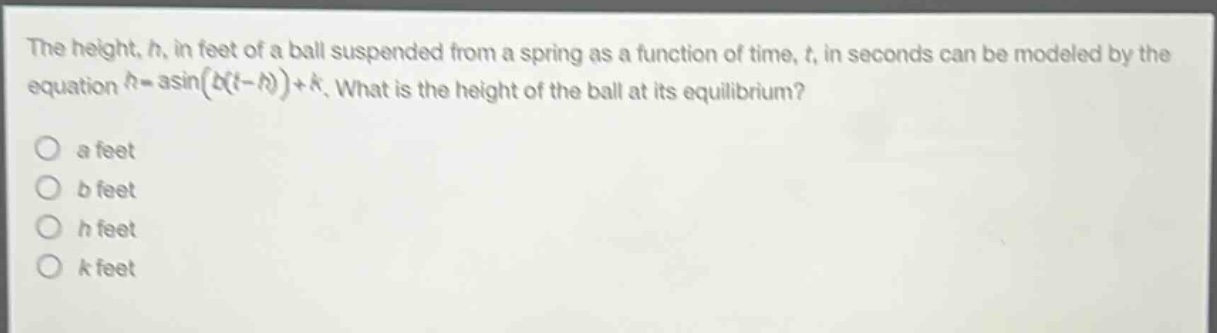
the height, h, in feet of a ball suspended from a spring as a function of time, t, in seconds can be modeled by the equation h = a*sin(b(t - h))+k. what is the height of the ball at its equilibrium?\no a feet\no b feet\no h feet\no k feet
Answer
Explanation:
Step1: Recall equilibrium concept
At equilibrium, the sine - function part of the equation $h = a\sin(b(t - h))+k$ has its value at the mid - point of its range. The range of the sine function $y=\sin(x)$ is $[- 1,1]$. The mid - point value of the sine function occurs when $\sin(b(t - h)) = 0$.
Step2: Substitute into the height equation
When $\sin(b(t - h)) = 0$, the equation $h=a\sin(b(t - h))+k$ becomes $h = 0 + k$.
Answer:
D. $k$ feet