the height, h, in feet of a ball suspended from a spring as a function of time, t, in seconds can be modeled…
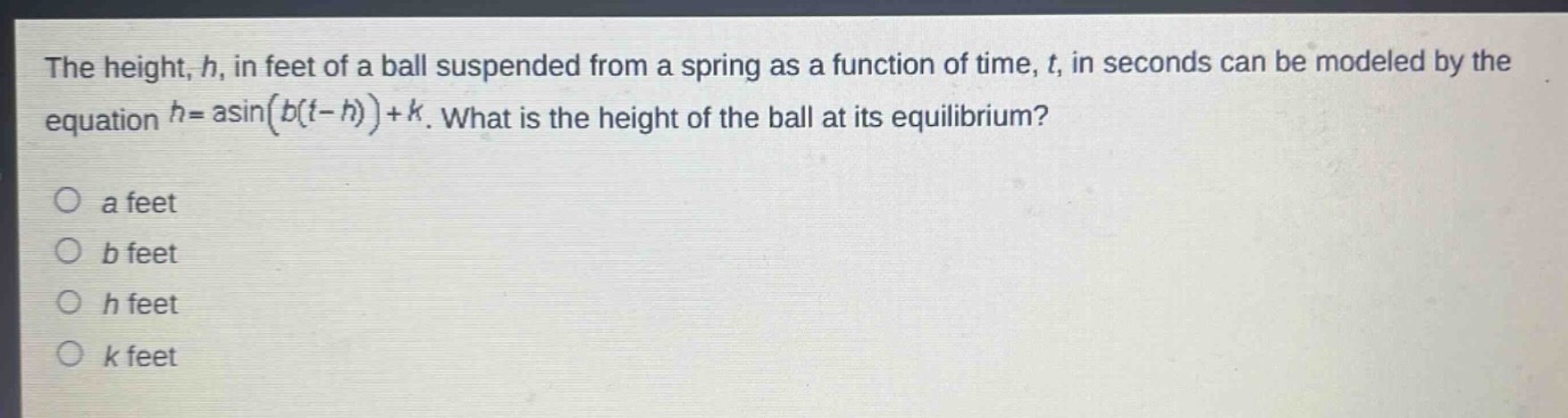
the height, h, in feet of a ball suspended from a spring as a function of time, t, in seconds can be modeled by the equation h = a*sin(b*(t - h))+k. what is the height of the ball at its equilibrium?\no a feet\no b feet\no h feet\no k feet
Answer
Answer:
D. $k$ feet
Explanation:
Step1: Recall the properties of the sinusoidal - function model
The general form of a sinusoidal function for vertical displacement is $y = A\sin(B(x - C))+D$. In the context of the height - time function $h=a\sin(b(t - h))+k$, the value of $k$ represents the vertical shift of the sinusoidal function.
Step2: Understand the equilibrium position
The equilibrium position of a vibrating object (in this case, the ball on a spring) modeled by a sinusoidal function is the mid - point of its vertical motion. For a sinusoidal function $y = A\sin(B(x - C))+D$, the mid - value of the function occurs when $\sin(B(x - C)) = 0$. When $\sin(b(t - h))=0$, the height $h$ of the ball is given by $h = k$. So the height of the ball at its equilibrium is $k$ feet.