the height of an object after it is released can be modeled by the function $f(t)=-16t^{2}+vt + s$, where…
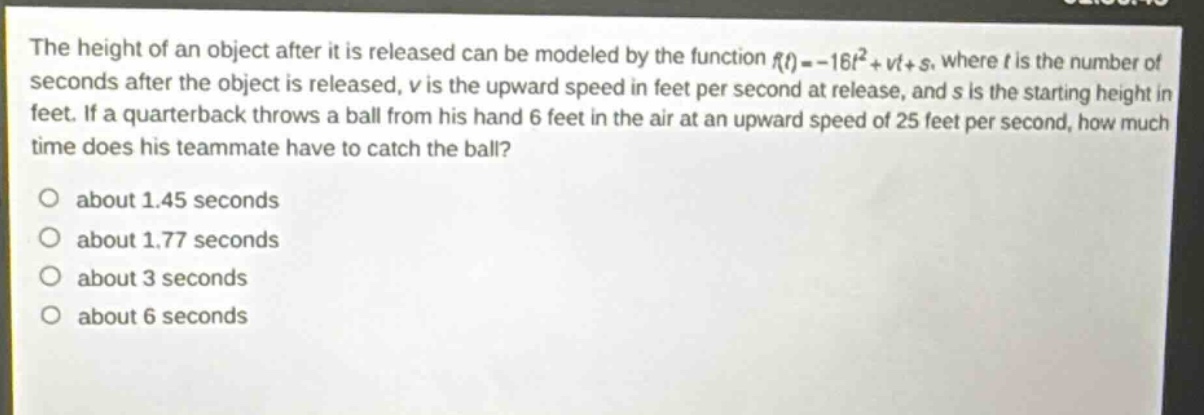
the height of an object after it is released can be modeled by the function $f(t)=-16t^{2}+vt + s$, where $t$ is the number of seconds after the object is released, $v$ is the upward speed in feet per second at release, and $s$ is the starting height in feet. if a quarterback throws a ball from his hand 6 feet in the air at an upward speed of 25 feet per second, how much time does his teammate have to catch the ball?\no about 1.45 seconds\no about 1.77 seconds\no about 3 seconds\no about 6 seconds
Answer
Answer:
A. about 1.77 seconds
Explanation:
Step1: Substitute values into formula
Given $v = 25$, $s=6$, and when the ball is caught $f(t)=0$. So the equation is $0=-16t^{2}+25t + 6$.
Step2: Use quadratic - formula
The quadratic formula for $ax^{2}+bx + c = 0$ is $t=\frac{-b\pm\sqrt{b^{2}-4ac}}{2a}$. Here $a=-16$, $b = 25$, $c = 6$. First, calculate the discriminant $\Delta=b^{2}-4ac=(25)^{2}-4\times(-16)\times6=625 + 384=1009$.
Step3: Calculate $t$ values
$t=\frac{-25\pm\sqrt{1009}}{-32}$. We have two solutions for $t$: $t_1=\frac{-25+\sqrt{1009}}{-32}$ and $t_2=\frac{-25 - \sqrt{1009}}{-32}$. Since time cannot be negative, we consider the positive - valued solution. $\sqrt{1009}\approx31.76$. Then $t=\frac{-25 + 31.76}{-32}\approx1.77$ seconds.